From September through November, a young - geologically speaking - and rocky island off the Pacific coast of Baja, Mexico, turns into the world's premiere site for viewing great white sharks. Isla Guadalupe, a government-protected biosphere, becomes home to a migratory group of 70 to 100 white sharks, ranging from 12-foot hyperactive males to enormous 18-foot females. During this time, a cadre of international shark ecotourism operators play host to divers, photographers, and the curious thrill-seekers by providing cage diving experiences, enabling people to view these impressive predators in their natural environment.
It is often a game-changing experience for those who consider these sharks as the ultimate, malevolent denizen of the deep. Instead they typically come away with a new-found respect for these magnificent animals, both impressive and endangered, and hopefully they will return home with an appreciation and concern for the threats these sharks face in today's world.
I have just returned from my 17th trip to Isla Guadalupe, spanning 7 years of filming these sharks either for my documentary, Island of the Great White Shark, or on a film assignment, or for stock footage. At the end of each season, I always find myself thinking, "Well maybe that's enough," and yet each fall I am drawn back to this remote spot once more. Such is the allure of the great white shark; there are other sharks that are more beautiful, more exotic, or even more endangered, yet there is something about this particular animal that has found a place in my subconscious.
On this particular trip, I was accompanying my good friend and photo-journalist, Budd Riker, who was there to do a magazine article. This was Budd's first trip to Isla Guadalupe and his first chance to see white sharks in the wild. The trip was arranged by Shark Diver and we were aboard the MV Horizon along with 14 other paying passengers. This would be a somewhat low-key trip for me; whenever I am aboard with paying passengers then my filming techniques become more conservative, confining myself to the cage, as I do not want anyone to assume that they can take the same risks that I do as a paid professional.
This afforded me more time to relax and view these animals without worrying about lighting, exposure, focus, and all the other things that fill your mind when you are hoping to turn a brief encounter into a long-lasting film or video image. This more leisurely pace also allowed me to think back on other memorable trips and memorable sharks - most of these sharks migrate back to Isla Guadalupe year after year and they are easily recognizable, so it's a bit like a reunion and seeing old friends once again.
In particular, I have a sweetheart at Isla Guadalupe: "Mystery," an 18-foot, beautifully proportioned female, stunning in her size and grace in the water. In 2006, while at Isla Guadalupe to get a few remaining shots for Island of the Great White Shark, Mystery appeared to me for the first time and spent two full hours being curious as to the bait offered by the boat and equally curious as to the diver in the water with the large camera. Time and time again she would cruise directly towards me and turn at the last moment, right in front of my lens, providing me with wonderful close-ups. Upon my return home, I re-cut several scenes in my film to take advantage of the magical moments this one particular shark had provided me.
So impressed was I with Mystery that, on a future trip in the Bahamas, I met sculptor Bill Wieger and commissioned him to do an accurate, museum-quality rendering of my favorite white shark based on my video footage. The end result has become a regular feature of Bill's line of animal sculptures but Mystery #1 hangs on my living room wall - a reminder of a special moment in time when nature was most accommodating.
However, for the next two years Mystery was not seen at Isla Guadalupe. Sometimes the white sharks, particularly females, will skip a year. Researchers are not exactly sure why: Does it have to do with reproduction or gestation? Do they simply just stay in one place or travel to a different location? There's no definitive answer yet - one of the many unsolved mysteries regarding these animals - but an absence of 2 years or more is always a reason for concern as the shark may have run afoul of commercial shark fishermen or perhaps was fatally injured in an altercation with another shark.
Or it could have succumbed to natural causes. The life span of a great white shark is estimated to be around 30 to 35 years, but that is an estimate based on the ages of other species and the age of mature white sharks caught by fishermen. No one has found a white shark dead of old age.
I was beginning to worry about the fate of Mystery when, near the end of the 2009 season, she had been spotted at Isla Guadalupe. But she was not seen the following year and had not been spotted this season so far. So once again, I began to wonder if my favorite shark model had met a sad end. Long-standing regulars like "Shredder," a large male who has visited the island every year for the past 10 years, had made appearances - but no Mystery.
During our stay at Isla Guadalupe, we were visited by Dr. Mauricio Hoyos, a prominent researcher of the island's white sharks. I first met Mauricio when he was just a grad student studying under Dr. Felipe Galvan of Mexico's marine institute, CICIMAR, and Dr. Pete Klimley of UC Davis. I featured Mauricio in my documentary and we have remained friends ever since. Mauricio has been coming to Isla Guadalupe each year to tag the sharks with transmitters and track their movements and other vital information so as to gauge the health of the population - he is undoubtedly "Dr. White Shark" of Isla Guadalupe.
As he approached the Horizon in the small boat he uses for tagging, Mauricio announced that there were several new sharks spotted so far this season: several new males and a couple of large females. In fact, over the course of our stay, we saw two new males and one female that were new to the island. Individual great white sharks have unique markings, much like fingerprints, and all the sharks that are seen at Isla Guadalupe are numbered and cataloged for future identification.
And then Mauricio added one more shark that had been identified recently that made me throw my hands up in a combination of joy and relief: Mystery had been spotted. It was getting a bit late in the season but the ol' girl that had graced me with such marvelous images years before finally made an appearance. Later that day, we were visited by a very large female and many thought it might be Mystery but I saw that it lacked her distinctive dark mark, like a birthmark, on the fourth gill slit on the left side. It turned out to be female #109, a very impressive animal and the largest shark seen during the trip.
But even though Mystery and I did not get a chance to meet and say hello after all these years, I was content knowing that she had been spotted. I suppose it's all a bit silly. And, given their estimated life span and the threats that they face year in and year out, it is inevitable that sharks like Mystery and Shredder will disappear from Isla Guadalupe forever - that's nature's cycle of life. However, that is the power of having the opportunity to see these sharks - and many other animals - in the wild. If done responsibly, ecotourism can impress upon the participants both the beauty and fragility of our ecosystems and the importance of protecting them for their own sake and ours.
This past weekend, my dive buddy, still photographer Bidd Riker, and I tried once again to dive on the wreck of the "ACE" off the coast of San Clemente, California. I say tried once again, because this was to be our 4th attempt at trying to reach the ship. Three previous attempts were met with poor visibility to the extant that it made for unsafe dive conditions. We were past the "third time is the charm" mental attitude and were now bordering on the "we better find this bloody #@!!% thing" philosophy.
The "ACE" is a 58-foot fishing boat - a drum seiner, to be exact - that sank in the fall of 2006 during rough seas with a full load of sardines and mackerel. With a measure of air trapped in its holds, the ACE drifted a bit across San Clemente's sandy bottom before finally settling down on its port (left) side at a depth of 114 feet. That drifting made it hard to locate for officials and salvagers, and so it remained out of sight until a year ago when a local dive boat charter set about to find the ACE based on rumors and speculation provided by local fishermen.
On this fourth attempt, Budd and I once again found visibility to be very poor at around 5-foot - not dangerous diving but certainly not what you're hoping for when shooting video and hoping to capture images that show the size and overall condition of the wreck. The ship is nearly covered from bow to stern with white metridium anemones which are startling for their bright white color against the backdrop of rusting steel and dark water. In addition, the ship is littered with sculpin, a type of scorpionfish, that prefer resting on the bottom quietly waiting for small fish to pass by and inadvertently become today's meal.
Wrecks of just about any size are fascinating subjects to film. Their appeal works on several different levels: they are something out of place (its supposed to be floating on the surface, not resting here in the murky depths); man-made objects are a testament to our folly either to the ravages of war, as with the South Pacific wrecks from World War II, or to underestimating the power of nature; and they can be marvelous artificial reefs that attract a wide variety of marine life.
However, on this occasion, there were to be no sweeping panoramic shots of the ACE - not when you can only see a few feet in front of your face. And that points out one of the challenges faced by nature photographers and filmmakers. You may have phenomenal skills and all the equipment in the world at your disposal, but you are still a slave to the devilish whims of mother nature. Many times, the footage you see on television or in the theater, or the images you see in books, are the result of many, many repeated attempts. And the more unusual the subject matter, whether it be a particular animal or a certain animal behavior (or simply a capsized fishing boat), the more challenging it can become to find just the right conditions that will enable you to get what you had hoped for.
But when the dice roll in your favor, you can come away with some startling imagery. And this can raise another issue: are we doing the oceans a favor when we show it in all of its visual glory, when we show the best of the best of our photographs of video? Or are we presenting the general populace with a false impression of the actual health of the oceans? When I have had the opportunity to speak with renown underwater photographer David Doubilet, he often asks this same question. Can we effectively talk about, say, fragile coral reefs that are in decline when every book on the subject is full of glorious and stunning images of vibrant fish and reef communities? One would hope that the viewing audience would appreciate the diversity and color of underwater life as seen in photographs and film and, by extension, want to preserve it. But it's a thought that gnaws away in the back of the minds of some of the great craftsmen who so beautifully chronicle the world's marine ecosystems.
For Budd and me, such heady questions needed no pondering this weekend. Skunked again by mother nature and its millions of sand particles, plankton, and animal larvae that can make for a thick soup of poor visibility, we decided we would try again in the fall when changing temperatures and currents can make for a few more days of acceptable conditions.
Of course, we're bound to hear how great it was the very next day. "Oh, you should have been there. . ." Shoulda, coulda, woulda - words to live by for the underwater filmmaker.
Last night, my long-standing dive buddy, Budd Riker, and I did a night dive at Shaw's Cove in Laguna Beach, California. Budd had been out to this dive location two nights before and was amazed at the range of sea life he came across. One round stingray after another, large mantis shrimp strolling across the sandy bottom, and surprisingly good visibility considering the flat sandy bottom of the cove.
But as can, frustratingly, often be the case when you come across an unusual occurrence, Budd had not brought his digital SLR camera that particular evening. And so here we were on Sunday, hoping for a repeat performance. On this dive, I kept my video camera at home (not much fun dragging a 70-pound rig through the surf) and was going to act as Budd's scout, using my underwater light to search for subjects to shoot.
We arrived as the sun was beginning to set. Some dark clouds were rolling in, but that did not matter to us (whereas in a daytime dive, losing the sun's ambient light would be a bit disappointing). Shaw's Cove has a large rocky reef structure to the right side that extends perhaps 200 yards out. At the moment, the tide had much of the top of the reef exposed and so Budd and I spent some time combing over the tidepools and recalling some of the many dives we had made here.
Budd has done literally thousands of dives at Shaw's Cove both for pleasure and when he used to be a scuba diving instructor. I had not done anywhere near as many, but still knew many of the contours of Shaw's Cove's reef structure. We talked of the "Crack" and grotto that runs across the reef and how much fun it was to investigate its many passages - always mindful of the occasional swell that could rush through, sending you on a roller coaster ride and slamming you against the rocks or a wall of spiny sea urchins if your timing was all wrong. Ah, the good times.
And so we waited for night to fall, reminiscing over past dives and noting how so many formations seem unchanged after all these many years. There seemed to be a consistency to the sea, a familiarity at Shaw's Cove that said, no matter what the ocean has been through, there are some things in life that never change. Now, with a black sky above, Budd and I suited up and waded through the very calm surf. Budd was ready for images of the many creatures he saw just a few nights ago. And I was ready to be his hunting dog, pointing them out to him.
That was the plan. The ocean saw things a bit differently that night.
We swam on the surface for a while before descending to 18 feet to begin our dive. Shaw's Cove has a wide sandy plain that drops off slowly, so one can travel quite a ways and still be relatively shallow - at several hundred yards off shore you can still only be at 25 to 30 feet in depth. We moved out slowly, keeping our eyes alert for those multitudes of stingrays and mantis shrimp.
But tonight was to be a very different night. First, I saw, through the beam of my light, what first appeared to be a considerable amount of particles floating in the water; sea grass pulverized by wave action perhaps. "Well, this loss of visibility won't make Budd very happy," I thought. Then I realized that the particles had an interesting dancing movement to them. Plankton! A multitude of minute larvae gyrating about - I felt like I was trapped in a goldfish bowl full of sea monkeys.
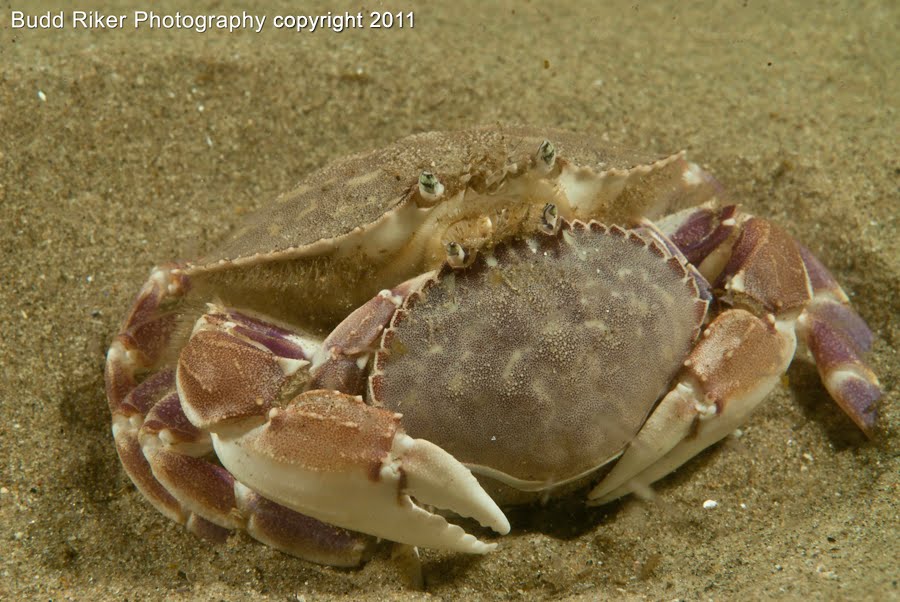
Next up on the changing menu was the contour of the sandy sea bottom itself. What was very flat a few nights ago, with small ripples in the sand, was now transformed into deeper ridges and valleys of sand, exposing purple sand dollars and allowing small ghost shrimp or juvenile halibut or flounder to find safe haven in the deep sandy depressions. Only a couple of small rays appeared and there were no mantis shrimp to be seen. Several types of crabs were scuttling about, raising their claws in defiance of the bright lights that gazed down upon them. We came upon two small crabs in the throes of conjugal bliss and while Budd snapped photos, the male slowly dug into the sand, holding fast to his mate and taking her with him. Oh, no. Hounded by the paparazzi once again.
And so what was familiar was now different. The sea can be a very fickle place. Some things can appear unchanged, dependable - this will last for eternity. And yet, below the waves, there is a very fragile and constantly evolving world taking place. Set into motion by waves, currents, temperatures, and the bio-rhythms of thousands of sea creatures, the yin-yang of the sea is susceptible to all of these influences and those imposed upon it by man.
Eventually feeling the chill of the early Spring water temperature, Budd and I surfaced and made our way back to shore. More surprised than disappointed that his hoped-for quarry had eluded him, Budd still had some great pictures from our dive. As we stepped out of the surf, we found that the dark clouds from earlier in the evening had now turned into a light rain; another reminder that our world is ever-changing.
It was a good dive and a reminder that we can never take the ocean and all that live within it for granted.
Saturday was to be an interesting day: diving on a newly found 100-foot wreck off of San Clemente, CA and then filming a brief introduction to a video I was preparing for a film festival/science conference. A busy day but a very satisfying one. At least that was the plan.
Wildlife filmmaking is infused with a high degree of serendipity - unusual animal encounters, shots of once-in-a-lifetime behaviors - along with an often equal measure of frustration when things don't quite go your way. You control only that which you can control, and the rest you just take as it comes.
My dive buddy, photographer Budd Riker, and I had heard about a newly discovered wreck several miles offshore from Southern California's San Clemente beach and we were looking forward to this first of what could be many dives. Ocean wrecks have always fascinated me. As a man-made structure, they seem eerily out of place underwater and yet they also can prove to be an attraction for a wide range of sealife, from schooling fish to algae, corals, and numerous small critters that take up residence in the iron and wood oasis.
But first you have to find it. The boat operators had marked the location with a buoy (which makes for an easy method to descend straight to the wreck, but today the buoy marker was no where to be seen. Lost in rough water or cut free by a grumpy lobster fisherman who felt his unspoken lobster trap territory was being encroached upon; whatever the cause, the crew's easy reference point was now gone and hopes for relocating it on the sandy bottom via sonar proved to be ineffective. Rock outcroppings provided tantalizing but ultimately disappointing sonar wild goose chases.
With time running out, the boat captain had to eventually abort all hopes of locating the wreck. He moved the boat to another site with kelp beds and rocky reefs to offer some sort of consolation prize for having missed out on diving the wreck. However, that turned out to be a disappointment too, as visibility could easily be seen from the surface as having the consistency of green-tinted cafe mocha. With that, all diving was scrubbed and the boat and its disappointed and embarrassed crew headed back to the harbor.
Well, at least I didn't have to spend part of my afternoon cleaning camera and dive gear.
On to plan B in the day's schedule: to shoot the video introduction. Budd and I scouted for a suitable location at Dana Point Harbor and found an interesting spot with rocks, trees, and ocean breakwater in the background. Well, at least I will be able to salvage something from my day, I thought. Oh, but I will have to wait a moment as this one recreational powerboat motors by; its throaty engine rumblings being picked up by the microphone.
Good. All clear. Oops, hold on; here's another one. Now a helicopter cruises over head. And another boat. Now I'm having people who are strolling along the harbor's edge, enjoying the day's great weather, stop and call out, "Hey, you guys making a movie?" Well, not at the moment, that's for sure.
Working in uncontrolled environments can often be very challenging when you have specific goals or objectives to meet. The yin-yang attitude of mother nature is not always conducive to specific agendas. But it's those occasional monkey wrenches that can and do make it interesting.
Fortunately, Budd and I are scheduled to return to the offshore wreck in two weeks, after the dive operator promised to have it once again marked by buoys and accurate GPS coordinates. And we got the introduction filmed the next morning in a different and, thankfully, quieter location - just minutes before rain, forecasted for the evening, decided to come early.
Hah. you missed me, mother nature. At least for the time being.
Saturday, September 20th marks the date for Ocean Conservancy'sInternational Coastal Cleanup. This is when we can all chip in - above and below the waves - to help clean up our local coastlines. More than a beautification project, it can also have a profound effect on the overall health of our local marine eco-systems.
According to the Ocean Conservancy, last year over six million pounds was cleared from the oceans and waterways - all documented. SIX MILLION POUNDS!
Check out the Ocean Conservancy web site to see where and how you can sign up to assist with collecting and documenting your efforts. I will be diving in Orange County, California waters with my good friend from PADI, Budd Riker, on behalf of Project AWARE.
Here's a perfect opportunity to make a direct contribution to cleaning up our water planet. Join in!
 From September through November, a young - geologically speaking - and rocky island off the Pacific coast of Baja, Mexico, turns into the world's premiere site for viewing great white sharks. Isla Guadalupe, a government-protected biosphere, becomes home to a migratory group of 70 to 100 white sharks, ranging from 12-foot hyperactive males to enormous 18-foot females. During this time, a cadre of international shark ecotourism operators play host to divers, photographers, and the curious thrill-seekers by providing cage diving experiences, enabling people to view these impressive predators in their natural environment.
 So impressed was I with Mystery that, on a future trip in the Bahamas, I met sculptor Bill Wieger and commissioned him to do an accurate, museum-quality rendering of my favorite white shark based on my video footage. The end result has become a regular feature of Bill's line of animal sculptures but Mystery #1 hangs on my living room wall - a reminder of a special moment in time when nature was most accommodating.