Where would you like to spend a faraway vacation? A remote chateau in France? A cozy cabin in the high Sierras? Well, here's one that is on my wish list: over 60 feet below the surface of the waves, off the coast of Florida, nestled in the Aquarius undersea research station.
 Currently, the only permanent undersea habitat and research facility, Aquarius is owned and funded by the National Oceanic and Atmospheric Administration (NOAA) and operated by the University of North Carolina Wilmington. It has been home to a wide array of scientists and researchers since it was first deployed in the Florida Keys Marine Sanctuary in 1993.
One of the advantages of an undersea habitat is the ability to extend the amount of bottom time (time spent diving and conducting research outside). If you were to dive from the surface to 60 feet, you would have only about one hour of dive time before you would find yourself having to deal with decompression (waiting to discharge accumulated nitrogen) as you surfaced. However, by  staying below in a pressurized facility, a scientist could spend a full working day outside, for up to 10 days or more. At the conclusion of the mission there would then be an extended period of time spent decompressing before stepping on dry land, but the ability to spend days at a time underwater is extremely valuable for many types of scientific ocean studies.
Additionally, a facility like Aquarius is ideal for testing how men and women can function in confined environments like they would encounter in deep space missions. NASA just concluded its latest deep space training exercise, NEEMO 15, which stands for NASA Extreme Environment Mission Operation. With NASA's future deep space missions, like ones being considered to the moons of Mars, Mars itself, and even to an asteroid (calling Bruce Willis), it is important to know how astronauts can function effectively and independently, with little or no contact with mother Earth. Medical emergencies, software and hardware repairs, and of course, long-term isolation - all need to be considered and studied.
 From reef growth to acidification to developing new techniques in biodiversity studies - or even preparing astronauts for future space missions - Aquarius is a vitally important ocean research center. NOAA understands the value of public awareness and has established and interesting website for Aquarius, containing background information on missions and other accomplishments, videos, pictures, and even a live feed camera for when it's catering to visitors.
So, champagne and strawberries in a New York hotel suite? Fresh tempura in a Tokyo high-rise? A warm fire and a soft couch in Yosemite? All very nice, but give me a cup of hot chocolate, a bunk, a porthole, and a set of diver gear at the ready and I'll be just fine, thank you.
Read about Aquarius at NOAA's Aquarius website.
Read about NEEMO 15 and its work with Aquarius in the Huffington Post.
 There's a little bit of a Chicken Little groundswell running through the news and the blogospehere and probably by the end of the week, aliens from space, the CIA, or Mayan calendars will be fingered as the culprits. It all has to do with the Earth's shifting magnetic poles.
We think of the planet's magnetic fields as constant and dependable as the Northern Star. Every Boy Scout finds his way back to camp because he can count on his trusty compass to point North. And the magnetic fields also protect us. The entire magnetosphere helps to deflect much of the solar radiation emanating from the sun that bombards us in the form of solar winds.
But the Earth's magnetic fields are always in flux; the actual magnetic north and south poles are shifting, wobbling about on its axis due to forces taking place deep below the surface of the Earth where the fields are generated. Since the 19th century, when the position of the magnetic north pole was first identified, it has been moving from high in the North American Arctic towards Siberia. Through the 20th century, its movement was clocked at about 10 km a year, on average, but apparently it has been accelerating to around 40 km annually.
 This movement can manifest itself as a real world consequence for us humans. It has been reported that an airport in Tampa, Florida had to close its runways so that they could be relabeled. Pilots use their magnetic compass instruments to determine which runway to use and so runway and taxiway signs apparently needed to be changed to properly coincide with aviation charts and the pilot's instruments.
"The Earth's poles are changing constantly, and when they change more than three degrees, that can affect runway numbering," FAA spokesperson Kathleen Bergen told Fox News.
Once in the news, the change in magnetic fields is rippling through the air and has been linked by some to the mysterious bird and fish deaths that took place recently in Arkansas and Delaware. I'm afraid soon we'll hear reports of a coming Armageddon, compliments of the Earth's magnetic field.
Well, what is happening? The Earth's magnetic fields are generated by the movement of the molten iron outer core around the planet's solid iron inner core. This movement, much like the movement of an electric motor, produces magnetic fields that extend thousands of miles beyond the planet forming our magnetospehere. The molten outer core is a very turbulent mass.
As described by NASA, "Sitting atop the hot inner core, the liquid outer core seethes and roils like water in a pan on a hot stove. The outer core also has "hurricanes"--whirlpools powered by the Coriolis forces of Earth's rotation. These complex motions generate our planet's magnetism through a process called the dynamo effect."
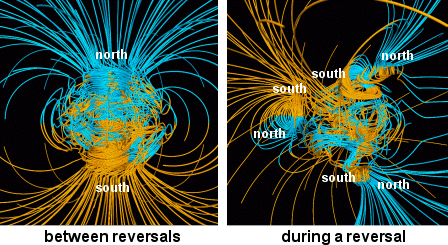
Could this movement of the magnetic poles be an indication of some major event? Scientists have been able to determine that there have been complete reversals of the magnetic poles throughout time - and I suspect this will put some doomsday theorists into a lather with pronouncements of catastrophic upheavals akin to the movie mayhem seen in "2012". However, 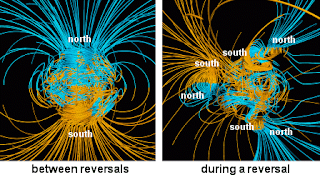 these reversals occur roughly every 300,000 years on average, with the last one taking place over 780,000 years ago. According to scientists, it takes thousands of years for a reversal to take place, and they theorize that it would be less of a complete reversal as it would be a fragmented disruption that would leave the Earth temporarily with several poles around the globe, not just a single North and South. And through it all, the Earth's geographic North/South pole, the axis on which it spins, would remain stable.
You just might find your GPS acting a little funny and, as NASA mentioned, you might find Tahiti as the new go-to location to watch the Northern lights.
Read about the Tampa airport runways on YahooNews.
Read about the magnetic fields in NASA Science.
 Where would you like to spend a faraway vacation? A remote chateau in France? A cozy cabin in the high Sierras? Well, here's one that is on my wish list: over 60 feet below the surface of the waves, off the coast of Florida, nestled in the Aquarius undersea research station.
 Currently, the only permanent undersea habitat and research facility, Aquarius is owned and funded by the National Oceanic and Atmospheric Administration (NOAA) and operated by the University of North Carolina Wilmington. It has been home to a wide array of scientists and researchers since it was first deployed in the Florida Keys Marine Sanctuary in 1993.
 staying below in a pressurized facility, a scientist could spend a full working day outside, for up to 10 days or more. At the conclusion of the mission there would then be an extended period of time spent decompressing before stepping on dry land, but the ability to spend days at a time underwater is extremely valuable for many types of scientific ocean studies.
 From reef growth to acidification to developing new techniques in biodiversity studies - or even preparing astronauts for future space missions - Aquarius is a vitally important ocean research center. NOAA understands the value of public awareness and has established and interesting website for Aquarius, containing background information on missions and other accomplishments, videos, pictures, and even a live feed camera for when it's catering to visitors.