Showing posts with label shark conservation. Show all posts

Wednesday, February 22, 2012

Post Script: Juliet Eilperin unveils shark ban critic's biased tactics

Just a quick coda to this past Monday's post, one of my favorite environmental journalists, Juliet Eilperin, wrote a brief but incisive article in The Washington Post National blog that sheds further light - a questioning light - on Dr. Giam Choo Hoo and the impetus behind his comments regarding the supposed ineffectiveness of shark fin bans.

It serves as a reminder that as the shark conservation cause continues to gain momentum, as demonstrated in recent days by both U.S. states New York and Maryland expressing an interest in shark fin prohibition legislation, we should not expect the opposition to simply throw in the towel. On the contrary, they will put up one heck of a fight and it will be based on half truths, blatant misrepresentations, and diversions.

We can expect to hear "Asia bashing" as a common accusatory tactic and I am sure there will be other bombs the opposition will try to hurl that will seem irrational and desperate in the face of overwhelming scientific evidence and just plain common sense. But be aware: as illogical as the opposing arguments may seem, if they can inflame the supporters of shark fishing and shark consumption then it can have an impact. You only need to watch five minutes of U.S. political news to see how effective diversion can be - underhanded, but effective.

Click here to read Juliet's post. Great analysis, Juliet. You nailed it, girl.

Source: The Washington Post

Monday, February 20, 2012

Philippine Shark Fishing Ban: senator pushing legislation to protect all sharks and rays

Philippine Senator Loren Legarda is receiving considerable coverage in local news outlets for her proposal to put forth legislation that would ban the catching of all sharks and rays in Philippine waters. Her proposal goes beyond the type of shark fin ban that has been initiated elsewhere, such as in several U.S. west coast states and Hawaii. Legarda seeks "to declare as unlawful the wounding or killing of sharks and rays, unless there is threat to human life or safety. The shark’s fin soup and the selling of shark’s fin will likewise be prohibited to eliminate the demand that results in the massive killing of sharks."

This proposal, Senate Bill 2616, was actually first proposed over a year ago, in November, 2010, and mirrors similar legislation that was proposed in July, 2010 by Representative Gloria Macapagal-Arroyo which has been languishing in committee since then.

The senator cites several arguments for pushing for this legislation,
“Sharks, as predators of the sea, play a vital role in regulating the ecological balance, particularly the health of important commercial fish species, population balance, and protection of coral reefs. Being a country with about two-thirds of the known marine species of the Pacific living in its coastal waters, the Philippines plays a crucial role in protecting marine species.”

Being that Senate Bill 2616 has been on out on the floor for some time, I find this sudden attention to be of interest. This morning, I counted five different Philippine news outlets picking up the story and, as much of what I read was verbatim from one source to the next, it was clear that a press release had been circulated. News reports claim that the senator's renewed drive was a result of recent local reports of shark finning operations taking place, and there's no reason to doubt that.

“Clearly, the absence of the law forbidding the catching of sharks, gives people the courage to continue the practice, which could eventually lead to the extinction of shark species in the country, especially [sic] that they reproduce slowly,” said Legarda in a statement on Sunday.

However, the release of Legarda's statement could also be propitious as a response to recent statements made by a panel of experts at a forum held in Singapore and sponsored by the Institute for Southeast Asian Studies. Expressing their controversial views were Dr. Giam Choo Hoo, a member of the United Nations Convention on International Trade of Endangered Species (CITES), Prof. Steve Oakley of Shark Savers Malaysia and Hank Jenkins, president of Species Management Specialists. The three put forward the position that prohibiting the trade in shark fins will not dramatically reduce the number of sharks killed worldwide. They noted that many countries such as Germany, France, Australia and Iceland have long killed sharks for their meat.

“Even if shark’s fin were banned, these countries would continue to catch sharks for the meat,” said Oakley.

Giam used statistics from the UN Food and Agriculture Organization (FAO) to say that 70 percent of all sharks caught are done by local fishermen in developing countries who consume the entire shark, not just selling the fins. And Jenkins was critical of the statistics that are often used regarding the number of sharks caught worldwide. He questioned the accuracy of 73 million caught each year, saying that it was a manipulation of data originally research by marine scientist Shelley Clarke who put the number at 38 million in 2000 with a wide variance of 26 million to 73 million.

While the idea that shark finning is not the sole issue threatening sharks (albeit the most distasteful) or that catch numbers can be widely inaccurate and prone to manipulation are actually valid points of discussion and consideration, the manner in which they were presented in Singapore has raised the dander of many shark advocates (read here, here, here) and pro-shark organizations. The panel's most inflammatory statement was probably made when, as reported in The Jukarta Post, they insisted, "there is no evidence that live finning - cutting sharks’ fins off before throwing the sharks back into the sea - is a prevalent practice. 'Although practiced by some fishermen, it is illegal, relatively infrequent and condemned by the industry,' said Jenkins."

Just a few days following these statements, Senator Legarda reignites discussion and news buzz regarding her Senate Bill 2616. Coincidence? Perhaps, but it's not much of a stretch to imagine the Singapore news coming to the senator's attention and generating a reaction.

Definitely, the impact of shark finning and total shark consumption and the accuracy of the estimated numbers require more research. But they are not easy facts to ascertain. Extinction is the ultimate test bed for measuring the impact that sharks have on a marine ecosystem, but there is a wealth of data to date that can provide indications without going to such a ridiculously extreme approach. With more and more data, computer models can be further refined to determine impacts based on species and specific environments or locales.

Statistics regarding catch and population numbers will always be a bit elusive and subject to abuse. How many sharks are caught specifically for fins and/or meat versus how many are caught as accidental bycatch will always need to be extrapolated from sources of varying reliability. And when you add to that the number sharks that go unreported due to illegal activity, it becomes even more challenging. However, even a low end number like Clarke's estimated 38 million is an astounding toll to impose on an animal being caught in the wild whose reproductive rate is low. To reach a level of commercial "sustainability" is a lot to ask of nature when it comes to sharks.

So, we can either downplay the potential or theorized impacts on shark populations and proceed as we have been for decades, waiting for a possible negative outcome that would be irreversible; or we follow Senator Legarda's lead and move towards total protection. That would require facing stiff economic and political challenges in transitioning market demands and the direction of commercial industries, ranging from fishing to tourism, but it would be a fine testament to our ability - some would say a god-given right - to exercise true stewardship of the seas.

Source: Manila Bulletin.com
Source: GMA News
Source: Business World Online
Source: philSTAR.com
Source: Journal Online
Source: Jakarta Post

Sunday, February 12, 2012

Sharks & Oxygen Depletion: the final word, hopefully, from a shark scientist

Here is a long but valuable post script to my comments at the start of the month regarding the pseudo-scientific concept that without sharks the Earth would lose it's oxygen. My shark advocate colleague, David Shiffman (aka WhySharksMatter), weighed in with his detailed scientific perspective (see below). So I hope this will bring some closure on the subject.

For those shark advocates who have supported this idea, I hope that you will re-assess your position and stick to scientifically-proven facts; there are enough of those to make a strong case for shark conservation. And for those who are mildly curious about sharks, please know that there are serious implications to the extinction or near-extinction of major shark species, whether sought after as a commercial item or simply a product of unfortunate by-catch. But finding yourself trapped in a planetary vacuum is not one of them.

Great post, David. Thanks!


“Sharks create oxygen”: A scientific perspective

I want to apologize to our regular readers for stating something that should be incredibly obvious. Sharks are in no way connected to the global supply of atmospheric oxygen. If every single species of shark went extinct, there would be a variety of negative ecological effects, but a reduction in the global supply of atmospheric oxygen would not be among them. There is not a shred of scientific evidence supporting the idea that the loss of sharks would affect our oxygen supply- not a single scientific paper, not a single technical report. I’ve attended a dozen scientific conferences focusing on marine ecology or shark biology (including three international conferences) and I’ve never seen or heard of anyone presenting or even discussing this. To the best of my knowledge, not a single person who has authored a scientific paper or technical report supports this idea. Despite the complete lack of any kind of credible evidence, and despite many recent blog posts thoroughly debunking it (see here here here here here here and here ), this pseudoscience just won’t die.

The premise of the sharks and oxygen claim is as follows:

A) Sharks, many of which are apex predators, are important in regulating marine food webs;
B) Phytoplankton, which create oxygen through photosynthesis, are in marine food webs;
C) Therefore, without sharks, phytoplankton populations will crash and we won’t have any more oxygen and we’ll all die.

A and B are reasonable enough- we know that under certain circumstances, apex predators can play important roles in structuring and regulating food webs, and we know that phytoplankton produce oxygen (though how much oxygen phytoplankton produces is another debate entirely). It’s part C of the sharks and oxygen claim that’s the problem.

This flawed leap in logic, like many other bits of pseudoscience, is loosely based on reality- specifically, the concept of the “trophic cascade”. To explain a trophic cascade, consider a simple hypothetical food chain where grass is the primary producer, goats consume grass, and chupacabras consume goats. Trophic refers to “trophic level”, an alternative term for a step of a food chain. Grass would be trophic level 0, goats would be trophic level 1, and chupacabras would be trophic level 2. The cascade refers to ripple-like effects that travel throughout a food chain despite initially affecting only one level- for example, a change in chupacabra populations could eventually affect goat populations, which would eventually affect the grass.

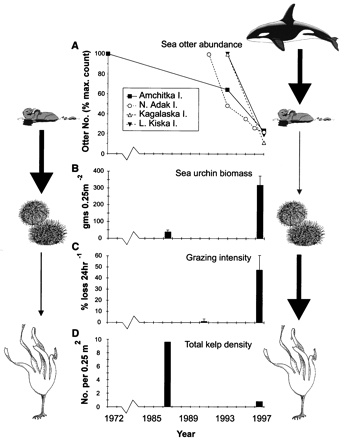
One classic example of a marine trophic cascade comes from Estes et al. 1998. In the original kelp forest system, kelp provided habitat for countless species of fish. Sea urchins ate kelp, but their numbers were kept in check by sea otters. Once orca whales began preying upon sea otters, sea otter populations decreased. With fewer sea otters eating them, sea urchin populations increased- and ate all of the kelp.

Figure 1 from Estes et al. 1998. " (A) Changes in sea otter abundance over time at several islands in the Aleutian archipelago and concurrent changes in (B) sea urchin biomass, (C) grazing intensity, and (D) kelp density measured from kelp forests at Adak Island. Error bars in (B) and (C) indicate 1 SE. The proposed mechanisms of change are portrayed in the marginal cartoons—the one on the left shows how the kelp forest ecosystem was organized before the sea otter's decline and the one on the right shows how this ecosystem changed with the addition of killer whales as an apex predator. Heavy arrows represent strong trophic interactions; light arrows represent weak interactions."

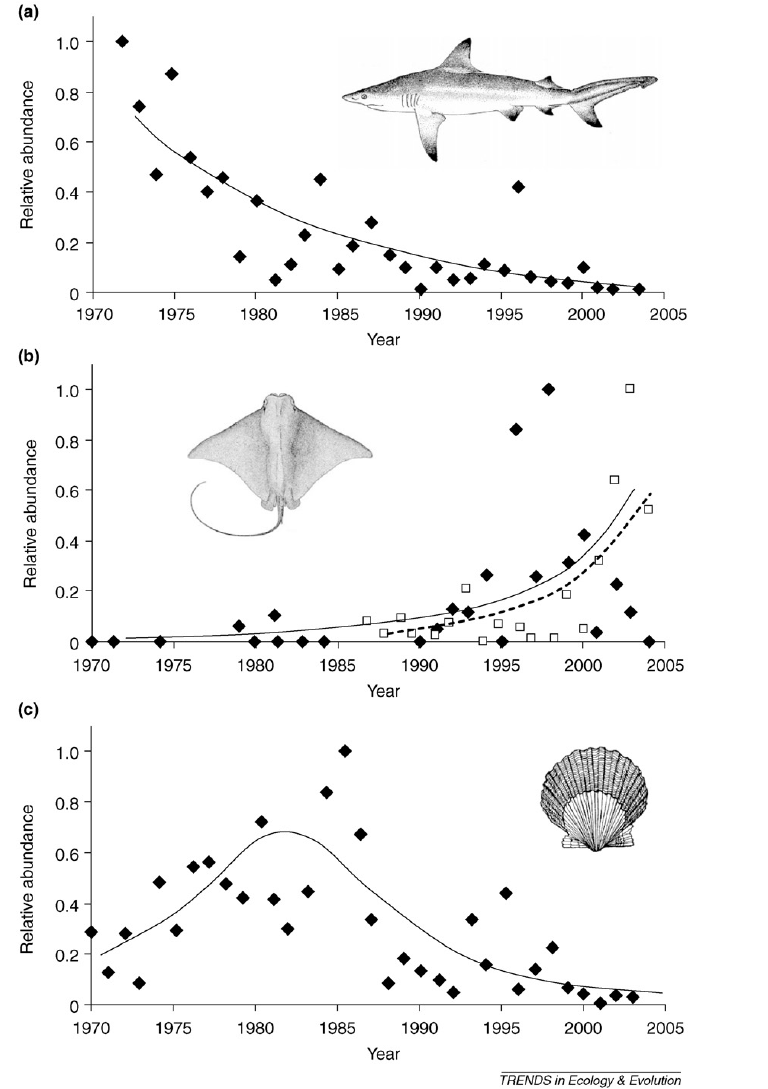
A similar trophic cascade involving sharks was reported in Myers et al. 2007, though these conclusions are still considered controversial among the scientific community. According to this paper, in the Outer Banks, a decrease in shark populations led to an increase in the populations of these sharks’ prey (including cownose rays), and increased cownose ray populations led to a decrease in their prey (including scallops, which used to be the basis for an important coastal fishery).

Figure 1 from Heithaus et al. 2008, a review of shark ecosystem effects, referencing the Myers et al. 2007 conclusions. "The removal of marine predators can result in cascading effects through communities. As (a) catch rates of large sharks, such as blacktip sharks (Carcharhinus limbatus), declined during research surveys along the east coast of the United States, (b) cownose rays began to increase, leading to eventual declines in (c) catches of North Carolina bay scallops (Agropecten irradians). Population densities are expressed as proportions of the observed time series maximum. Trend lines are best fits from generalized linear (a,b) or additive models (c). In (b), filled symbols and line denote Delaware Bay surveys, and open symbols and dashed line are Pamlico Sound, NC, surveys. Field experiments confirmed that scallop declines resulted from increased ray predation [5

There have been numerous models and observational studies concerning the ecological effects that would result from the loss of apex predators (a partial list can be found in my sources below). Not a single one mentions even the remote possibility of a decline in the global supply of oxygen as a consequence of overfishing sharks. If you encounter someone promoting this (or any of a huge variety of pseudoscience claiming to be based on real science), ask them for a copy of the peer-reviewed scientific paper which supports it.

Technically speaking, just because no one has ever written about this phenomenon applying to sharks doesn’t, in of itself, mean that it doesn’t apply to sharks. However, there’s a very good reason why the loss of sharks won’t affect phytoplankton. Trophic cascades tend to occur in simple ecosystems. In the kelp forest, basically only one type of organism eats kelp from the base (sea urchins) and basically only one type of organism eats sea urchins (otters). Sharks fit into different ecosystems differently, and many of those ecosystem are quite complex, so the claim that the loss of sharks will have a uniform global effect is inaccurate at best.

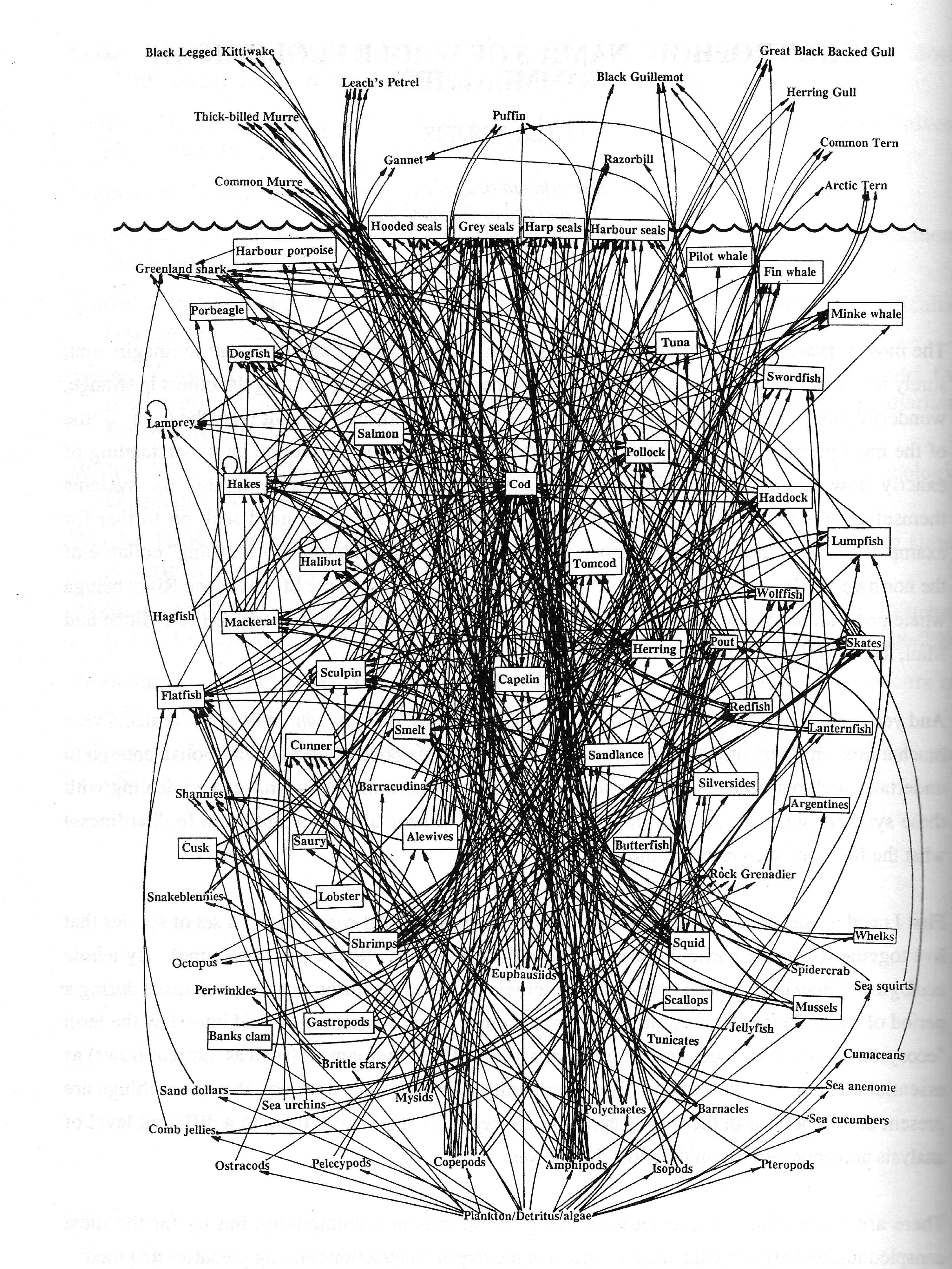
Research from coral reef ecosystems shows than when predator/prey interactions are more diffuse (for example, a system might have many herbivores, many secondary consumers, etc.) , trophic cascades don’t occur. Sharks may eat some herbivores, but they also eat animals that eat those herbivores, so the ecological effects would be less direct. Additionally, even if one prey species experiences “predation release”, other species with similar ecological niches are not affected in the same way. In a complex ecosystem, sharks can be considered to be “trophically decoupled” from phytoplankton- their populations will not affect those of phytoplankton because the trophic relationships are diffuse and complex. Most marine ecosystems are quite complex, as seen below:

A cod-based food web in the North Atlantic, a region of the ocean with relatively FEW species. Image from David Lavigne, National Science and Engineering Research Council

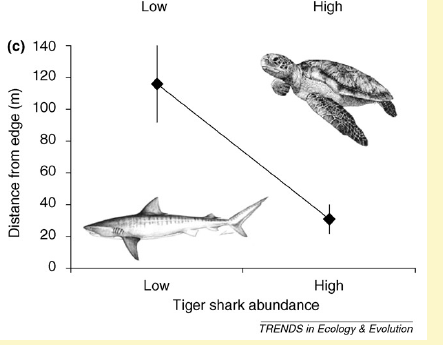
In fact, emerging research in the field of fear ecology has shown that the most important effects resulting from the loss of sharks in an ecosystem may actually be indirect and related to behavior rather than population structure. In other words, sharks may exert more of an influence on an ecosystem by causing organisms in that system to alter their behavior to avoid being eaten. A great example of this comes from Dr. Mike Heithaus’ work in Australia. He found that animals like dolphins, sea turtles, and dugongs (relatives of manatees) will alter their preferred foraging ground during times of the year when large tiger sharks are present. They will forage in areas with less food but less chance of encountering a tiger shark.

Figure 2 from Heithaus et al. 2008. "Risk effects of tiger sharks on megagrazers in Shark Bay, Australia....Green turtles in good body condition (assumed to indicate a good energy state) shift to safe microhabitats with nutrient-poor seagrass when sharks are common"

Many species of sharks have been dangerously overharvested, resulting in alarmingly rapid and severe population declines. The loss of sharks can result in disruptions to the food web, resulting in ecological (and in many cases economic) problems. Conservationists are correct to be concerned about the loss of sharks and the effects this will have on our oceans, and we can and should work to protect these animals. However, sharks have absolutely nothing whatsoever to do with the global oxygen supply. There is absolutely no evidence in favor of this claim, and lots of evidence against it.

Spreading inaccurate claims in support of a worthy cause can only harm that cause by reducing credibility with the public and with policymakers. There are enough real reasons to protect sharks that we shouldn’t need to make up nonsense with no factual basis. I call on all responsible conservationists and advocates to stop perpetuating this pseudoscience.

Source: Southern Fried Science

Wednesday, February 1, 2012

Shark Conservation: in a complex world, only hard facts truly serve the cause

Nature is a very complex, interwoven web of plant and animal species, ecological and environmental relationships, and an endless multitude of actions and reactions. To survive, it is constantly changing, adjusting to shifts in conditions - sometimes slowly and sometimes dramatically. Therefore, to predict the totality of change that occurs with the loss of a species is, to say the least, challenging. We like are answers neat and tidy. We are prone to look for silver bullet solutions, one size fits all remedies, and we have a tendency to view consequences in linear domino-like chains.

However, when you speak with ecological scientists, they think in terms of trophic cascade when considering man's impact on the environment. Changes are not simple and the ultimate outcome - particularly when nature is constantly trying to adjust for the sake of survival - becomes extremely hard to predict. It can be done but it requires complex modeling and varying degrees of confidence, and is often couched in the realization that other mitigating factors can alter the outcome of a particular situation for better or worse.

In the area of shark conservation, to stress the urgency of their cause sometimes passionate shark conservationists will predict outcomes involving the loss of sharks that don't necessarily take a variety of factors into account. They are fervently trying to make a point and will sometimes use an "A equals Z" approach that I find can be counter-productive because it strains credibility. One such equation is that without sharks the planet will lose most of its oxygen. To borrow a popular Hollywood expression about excess, they are "jumping the shark" in trying to make a simple statement about the ramifications on the environment if sharks were pushed to the edge of extinction. It's meant to alarm people but it pushes the envelope of rational, science-based discourse beyond the boundaries of common sense. And the result is you can lose the very person you are trying to convert.

Two blogging colleagues in the shark conservation field - Da Shark of the blog, The Best Shark Dive in the World, and Shark Diver of Underwater Thrills:Swimming With Sharks - take great exception to the shark vs. oxygen theory. Their writings can reveal, shall we say, a colorful and blunt temperament at times but they make some solid points in several recent posts on the subject. It makes for some good and entertaining blogosphere reading.

Certainly, sharks need to be conserved and protected as they play a critical role in maintaining the balance of a marine ecosystem. But they are not the only players in the game. At the very least, sharks are emblematic of what is happening to a variety of important species, from tuna to wolves to polar bears. And collectively, the totality of losses can produce negative impacts that can push some of nature's systems and capabilities to perilous tipping points, exceeding it's ability to adjust or recover.

But we must be careful as to just how far we wish to go in capturing the attention of a yet unengaged audience. If we lose our oxygen from the loss of sharks, then do we keep or even gain more oxygen by saving all sharks? Does that mean that the effects of fossil fuels will be negated or that ocean acidification becomes yesterday's news? How the marine ecology of, say, Fiji would be impacted by a severe decline in the island's reef shark population could be quite different from that of the Bahamas, or the loss of pelagic sharks in the Pacific could have different repercussions in the Atlantic. It becomes a very complicated image when we try to look at the big picture and so comprehensive conclusions must be measured and well thought out.

Shark conservation is necessary and important because it shines a light on our ignorance and indifference and identifies an important player in nature's cast of thousands. However, if we are to get people on board to the plight of sharks and other species or environmental threats - whether on land, in the sea, or in the air - our efforts must be based on the solid and, admittedly, often complex evidence that science can provide. It is a complicated world we live in and simplistic declarations of doom do not serve the cause, no matter how sincere the intentions.

Monday, January 16, 2012

Filmmaker's Journal: Being reminded of the resources and support conservation needs

This past week, I was away from the RTSea Blog as I was on the road, traveling to Washington, DC and Columbia, South Carolina.

In Washington, DC, I briefly met with the members of the Pew Environment Group's (PEG) Global Shark Conservation Campaign, headed up by Matt Rand. PEG is an arm of the Pew Charitable Trusts and their focus is on making inroads in national and international policy. Much of what is currently proving to be fruitful in advancing the cause of shark conservation involves this higher political level. PEG's Global Shark Conservation Campaign has been involved in some noteworthy successes of late, particularly the establishment of shark sanctuaries in Palau and Honduras. The group is now looking forward to an upcoming CITES meeting this year and the next United Nations-sponsored FAO meeting wherein they will discuss revitalizing a decade-old "international plan of action." It's at international events like these that policies regarding the protection of sharks in international waters - outside the borders or boundaries of national marine protected areas or sanctuaries - can be hammered out.

From the U.S. capitol, I then moved south - through a tiring, circuitous route of flights - to Columbia, South Carolina to film a corporate video for a major pharmaceutical company. The location was an oncology (cancer) treatment center and I was very impressed by the range of services and the quality of care this facility was providing cancer patients.

In scouting various potential locations within the center for filming, we were shown many of the treatment areas and, at one point, the head of the facility brought out some of the chemotherapy medications that are currently being used. Some of these medications cost as much as $2500 per injection and patients would be receiving these treatments sometimes as often as twice a week.

It made me ponder on one of the challenges that conservation issues face. Mankind invests a considerable amount of effort and expense in treating disease, partly because, if we look at it as "connect the dots," it's a very short and simple connection. Many of us falter when it comes to, say, issues of diet and obesity because there are a few more dots to connect before we see a consequence that has personal impact.

And for many people, conservation is a long series of connecting dots and the immediate or personal consequences begins to feel remote. But the impact(s) of dismissing conservation are very real, as real as any cancer, and while we all certainly need to care for ourselves and others who may be afflicted by disease, we must also be aware that the planet is ailing and if we choose to ignore this one patient, Earth, we could be setting ourselves up for a terminal condition that is beyond a cure.

As we wrapped up filming after two days, I thought of the hundreds of patients that come through this oncology center's doors each day. It was comforting to know that these people had a place to go and that medications were available, albeit costly because of the challenges in manufacturing and the exclusive nature of these medications. Now, if we can get more people to see that conservation needs as dedicated a commitment in effort and resources, we just might be able to prevent the planet and the human species from flatlining.

Sunday, November 27, 2011

David Shiffman: new generation of shark researcher seeks your vote

As a filmmaker, one of the reasons I write the RTSeaBlog is because through my work I have come to see that there is a tremendous amount of important research and data which is not making its way to the decision makers or the general public. This is true in the environmental and ecological field as well as in other disciplines. But I am certainly not alone in this understanding and there is a growing group of young scientists determined to change that status quo.

David Shiffman, also known as "Why Sharks Matter" at the Southern Fried Science blog, is one of a new generation of marine scientists who both relishes in research and understands the importance of communicating that research to the widest possible audience through today's various online mediums. He currently is working on his doctorate as a research assistant at the R.J. Dunlap Marine Conservation Program of the University of Miami.

David is also currently in the running as a finalist in the CollegeScholarships.org program that recognizes the efforts of college students and researchers who are utilizing the world of blogging to get the message out. The program is a cash prize awarded to the person with the greatest number of votes from the public.

"[The scholarship] will provide me with $10,000 towards my dissertation research, focusing on the ecological importance of sharks to coral reefs. I'll also use the money to support our lab's citizen science program, which has taken over 1,000 high school students and teachers into the field to learn about sharks and participate in an active research program. I'll also adopt a satellite tagged shark in the name of Southern Fried Science's readers, let them name it through a contest, and post regular updates about where it is and what it's likely to be encountering."

Voting ends November 30th, and it's going to be close. David is the only ocean blogger among the finalists. It would be great if all the finalists could receive cash rewards and maybe someday, with a change in the economy or the mindset of those who don't see conservation as a critical issue, that could happen. But, for the moment, this is what we have.

I have cited David and his blog work in previous posts. I met David several years ago at the first BLUE Ocean Film Festival and can attest that he is dedicated to both sharks and the need for making people aware as to the plight of these animals and what it means to the future of the oceans as a whole. He's got my vote. How about you? You can vote for David by clicking here which will take you to the CollegeScholarships.org voting page (it accepts one vote each day).

Or you can cut and paste their web address: http://www.collegescholarships.org/blog/2011/11/18/2011-blogging-scholarship/
http://www.collegescholarships.org/blog/2011/11/18/2011-blogging-scholarship/

Saturday, November 19, 2011

ICCAT PostScript: silky shark afforded greater protection but other species ignored

Follow up to yesterday's post, "Sharks of the Atlantic: new report cites dismal international conservation efforts" . . .

The results of the ICCAT's 22nd Regular Meeting of the Commission in Instanbul, Turkey produced a mixed bag of results, leaning towards more disappointment than satisfaction. ICCAT agreed to establish greater protection for the silky shark - one of the most sought after sharks in the Atlantic shark fishing industry - but protections for the porbeagle, blue, and shortfin mako sharks were passed over, along with other important shark conservation measures that were recommended by Oceana and other conservation groups.

Maintaining a diplomatic stiff upper lip, an Oceana press release stated,
“'It is a great day for silky sharks,' said Elizabeth Griffin Wilson, senior manager of marine wildlife at Oceana. 'ICCAT should be commended for its continued effort to protect the oceans top predators. Today’s decision to protect silky sharks is a strong step forward in protecting one of the most commonly found species in the international shark fin trade.'

Oceana did voice concern that ICCAT failed to reach consensus on
several important shark measures, including those to protect vulnerable porbeagle sharks, establish science-based precautionary catch limits for blue and shortfin mako sharks and improve the current finning measure by requiring that sharks be landed with their fins wholly or partially attached in a natural manner."

Also in attendance at the ICCAT meeting were representatives of the Pew Environment Group.
"Protecting one shark species a year and adopting no other measures for their conservation will not be enough to ensure the survival of these animals across the Atlantic Ocean," said Max Bello, senior advisor on global shark conservation for Pew.

Progress with international organizations can be painfully slow and patience is one of the founding principals of diplomacy. However, incremental steps at this stage may not be enough to preserve endangered shark species like the porbeagle which, it has been reported by scientists, would need a minimum of several decades and possibly more than 100 years to fully recover.

Read Oceana's press release on the results of the ICCAT meeting.
Read comments from the Pew Environment Group in the
San Francisco Chronicle.

Wednesday, November 9, 2011

Cayman Island Tiger Sharks: tagging data shows possible Caribbean migratory patterns

The Cayman News Service reported that three tiger sharks that were tagged almost a year ago in waters off the Cayman Islands have returned having roamed the wide waters of the Caribbean. The original tagging project was a joint effort between the Department of Environment (DoE), Marine Conservation International (MCI), the Guy Harvey Research Institute (GHRI) at Nova Southeastern University and the Save Our Seas Foundation.

The three sharks were tagged with satellite tags which can provide a variety of data in addition to basic positioning information. One of the three sharks spent a great deal of time cruising the coast of Jamaica; another has been in deep waters off the Cayman Islands; while the third shark spent the summer in the southwest, off Honduras and Nicaragua.

While not necessarily covering the same long "point A to point B" distances that have been reported with sharks like great white sharks and whale sharks, the data does show that the sharks can cover a considerable amount of territory and that these movements might constitute "migrations" if there is a schedule or pattern to their journeys.

Being able to verify that sharks frequent the Cayman Islands via migratory patterns might help give weight to the need to protect them - proving that they are not infrequent or fluke visitors not deserving of specific attention.

The Cayman News Service reported,
"Despite their precarious situation, there is no law to protect sharks in Cayman waters but hopes for the species have been raised in the region following the ban on shark fishing by Belize, Mexico, St Maarten, Honduras and the Bahamas. Timothy Austin, Deputy Director of the DoE, welcomed the ban by neighbouring countries. 'This will give a boost to the health of the marine environment for the Caribbean,' he said."

Read about the sharks in the Cayman News Service.

Saturday, October 29, 2011

Shark Conservation: CNN reports on sharks, their supporters and going shark-free

As a follow up to my Thursday post on CNN's report on ocean plastic pollution to air this Sunday, October 30th at 5pm and 8pm, also in the same program will be a segment on sharks and shark conservation efforts: Sharks: from predators to prey.

The segment will cover many of the issues that shark advocates have been promoting for several years, but it always bears repeating. Overfishing from commercial shark fishing operations, the high demand in Asian countries for shark products - particularly shark fins - and the critical role that sharks play as apex predators in maintaining a healthy and well-balanced marine ecosystem. These are the facts. Over-sensationalism, like rampaging sharks on the attack for humans at any opportunity, is what fuels misconceptions and provides fodder for a media looking for a quick headline. However, for the most part, CNN has done a pretty responsible job in putting forth the truth about sharks and the threats they face. So, kudos to the folks in Atlanta.

The shark segment on CNN this Sunday also looks at the Shark Free Marinas Initiative (SFMI) and its director, marine biologist Luke Tipple. Luke is a good friend and I've had the opportunity to capture him on film many times both above and below the waves, diving in open water with white sharks, tigers, and others, or talking about sharks and the Shark Free Marinas Initiative.

With location services set up by SharkDivers.com, CNN spent time with Luke in the Grand Bahamas where SFMI has a foothold with one of the island's most popular marinas catering to sportfishermen. Compared to commercial operations, the number of sharks taken by recreational sportfishermen is much smaller but at this stage of the game, the loss of any shark is a blow to the species' population.
Recreational shark fishing tournaments are still being held each year and draw considerable worldwide criticism from conservation groups like The Humane Society - which supports SFMI. But when sportfishermen either opt for catch-and-release of sharks or choose not to catch them altogether, it can have an impact on an influential segment of the ocean-going public that can spread.

Here's a video preview of the CNN news report:


CNN's Sharks: from predator to prey airs Sunday, Oct. 30th at 5pm & 8pm PST (8 & 11pm EST) on CNN.
Learn about the Shark Free Marinas Initiative.

Wednesday, October 19, 2011

Industrial Shark Fishing: shark conservation must do battle with Goliath

Shark conservation is a tough sell. I've said that before. For all it's groundswell popularity in the last few years, it continually suffers from a primal hesitation people have to fully embrace it. There are passionate advocates but in the larger scheme of things, we are still a small segment of the total population. But some progress is being made.

Over the past few years, we have seen shark sanctuaries established in a few island nations and several states in the U.S. have initiated shark fin regulations or bans. This is all good news and it represents a step in the right direction in trying to impact the market for shark fins and shark-related products.

However, the next challenge is also the most formidable one: taking it to an international level that confronts the powerful economic realities of the shark finning industry. This is where highly-placed influence peddlers work the back room deals to maintain the status quo. And from an ecological standpoint, this is where the real damage is taking place.

The Pew Environment Group has a series of photographs, freely available for media use, that are staggering in their illustration of the scope of the problem. Looking at these photos, taken in Taiwan, it doesn't take a rocket scientist to see that it would be literally impossible for a species whose reproductive rate is low, as is the case with sharks, to be able to survive such industrial-level harvesting. The photo at the top of this post and the two below were taken by Shawn Heinrichs for the Pew Environment Group:

According to The New York Times, four of the leading nations involved in commercial shark finning are Taiwan, Indonesia, India, and Spain. And several developing nations assist by providing some of the boats and the crew - at bare subsistence-level wages. And that brings up another challenge: if world opinion were to succeed in curtailing the practice, we would also have the responsibility of providing an alternative source of income for these low-paid workers and fishermen. For them, feeding their families is a much greater priority than preserving sharks.

Several nations that provide sanctuary protections for sharks unfortunately offer these safeguards in name only as they do not have the resources available to enforce their regulations. A recent example is the slaughter of 2,000 sharks in Colombia's Pacific marine wildlife sanctuary by commercial boats, reportedly of Costa Rican origin. With no Colombian naval vessels in sight, it was reported that up to 10 boats entered the protected waters, freely taking hammerhead, Galapagos, and whale sharks.

While generating grass roots-level advocacy is important, shark conservation must now move forcefully into the international arena, getting organizations like IUCN, CITES, ICAAT, and the United Nations to wake up to the realities of what is happening in international waters. It will not be easy. Those industrialists who benefit from the shark have a lot at stake; they will fight hard. And international diplomacy by its very nature is painfully slow. So, the reality may be that, long before we run an oil platform dry or see sea levels noticeable rise due to climate change, we may witness the extinction of many species of shark.

Therefore, shark conservation, as a movement, must focus its efforts not only on general public awareness but must also develop strategies to take on the industry directly on a global level. It may be akin to David facing Goliath, but according to legend, David won.

See more photos of industrial shark finning at the Pew Environment Group website.
Read an overview of the shark finning industry in the New York Times.
Read about the recent slaughter of sharks in Colombia in the
Guardian.

Saturday, October 8, 2011

A Week for Sharks: CA shark fin ban is now law, Australia concerned over shark diving

It's been a week for sharks, particularly in California. Governor Jerry Brown signed AB 376 into law which bans the trade and possession of shark fins in California. This was a critical piece in a mosaic of shark fin distribution in the northern Pacific ocean.

As reported by COARE (Center for Oceanic Awareness Research and Education), "California's ban complements bans in place in Hawaii, Washington, and Oregon, effectively shutting the west coast of the United States to fin traders. It is estimated that the United States is responsible for 70% of the world's fin imports outside of Asia. With a staggering 85% of those U.S.-bound fins passing through California, AB 376 will have a tremendous impact on shark conservation."

Now we must watch for where the next distribution hubs will appear - there's too much at stake financially for some of these shark fin distributors to simply throw in the towel. And there is also the concern over illegal activities.

But the tide does seem to be turning and other nations are considering tighter regulations or out right bans on shark products. My personal concern is that, for some of the general public, sharks have become the cause d'jour and while there are some hard working advocates who, I am sure, will keep the fires burning for more conservation and regulation, I worry that the general public might tire of the cause - in today's Information Age, attention spans can dry up in the blink of an eye - and without public support, commercial shark fishing lobbyists and business representatives will jump on the opportunity to sway politicians in their favor. Only time will tell.

"The world has been watching and waiting. With similar efforts underway in parts of Canada, and with a ban proposed in China, California's efforts hopefully will ripple into many other places," said COARE.

However, one avenue whereby people can appreciate sharks up close in the wild may soon be curtailed or at least limited. Australia is one of three or four primary locations in the world where people can cage dive to view great white sharks. But Australia's ABC News reports that there
are new findings that white sharks are staying in close to coastal areas, where they are often baited for the shark diving operators, and anecdotal reports of an increased number of shark/surfer encounters has some saying that the number of operators should be halved from four to two and that the number of days in which they can chum for sharks should also be reduced. (Click image to view video.)

There have been studies, both in Australia and Hawaii, that show that the sharks' response to chumming over a given period is a transitory behavior and does not equate into 1.) a significant change in the shark's normal feeding behavior and 2.) that the sharks do not equate the boat-supplied food with humans. However, some thought should be given to the fact that in Australia, they are currently chumming for white sharks as much as 270 days a year - double that of just a few years ago.

On a personal note, today I am leaving for San Diego, California to embark on my seventeenth trip to Isla Guadalupe off the coast of Baja, Mexico, compliments of Shark Diver. Isla Guadalupe is one of the world's premier sites for viewing great white sharks. A population migrates to the
island in the fall months and though Mexican government regulations have greatly scaled back any baiting of the sharks, there are still plenty of encounters to keep the cage-bound divers thrilled and satisfied. I will be accompanying my friend and photojournalist, Budd Riker on his inaugural trip as he takes notes and pictures for a future photo magazine article.

While some zealous Mexican conservation groups have expressed concern that the shark diving operators at Isla Guadalupe have, over the years, disrupted the normal behavior of these sharks; in the seven years that I have been coming to the island I have yet to see any evidence or reason for concern. When the sharks were more vigorously chummed and baited in the past, the sum total of what they consumed was a mere drop in the bucket compared to the normal requirements for their diet which, for adults, consists of primarily seals and sea lions. And as the sharks would inhabit the waters around Isla Guadalupe for just three to four months, it is reasonable to assume that they didn't spend the next eight months wasting away, waiting for when they would return to Mexican waters for some leftover fish parts.

So, I will be heading out in just a few minutes and will post a follow up when I get back in a few days. In the meantime, shark advocates, no time to rest on our California legislation laurels. There's still more work to be done.

Sunday, September 25, 2011

Hong Kong Shark Foundation: taking shark advocacy to the streets of Hong Kong

Shark conservation has grown over the years with some quantifiable progress in the form of legislation, regulations, and defined sanctuaries. There has been some improvement in advocacy and general public awareness. But there has also has been time, energy, and needed funds wasted over perhaps well-intended feel good campaigns whose results did nothing to move the needle in the direction of improved conservation.

Actually, that can probably be said of all conservation movements and so it is incumbent upon all of us who are interested in conservation issues to study the players and make sure that our efforts and support are directed to those groups who can bring about real change.

Regarding the issue of market demand in Asian countries for shark fin products, I was encouraged to see this small news item by the Associated Foreign Press and picked up far to the west in the Oman Daily Observer: a "plankmob" in the streets of of downtown Hong Kong to protest shark fins and shark fin soup. The event was planned for today, Sunday, by the Hong Kong Shark Foundation - an organization dedicated to conserving sharks and situated in the midst of one of the major trade centers for shark products.

"Supporters of the Hong Kong Shark Foundation march along a street to raise awareness for sharks killed each year for their fins, in Hong Kong yesterday. According to studies of the shark fin market up to 73 million sharks are killed each year, primarily for their fins used in shark fin soup. A bowl of shark fin soup can cost 100 USD, with a single fin being worth more than 1,300 USD."

Read about the Hong Kong Shark Foundation.

Monday, September 5, 2011

Demon Fish: an A to Z look at sharks and the world surrounding them

The summer has come to a close, Discovery's Shark Week has passed, sightings and shark incidents have once again brought out the "Summer of the Shark" hyperbole and so now, as the seas begin to calm, it's time for some well-written, intellectual discourse on the subject.

If one is interested in learning about sharks, there are quite a few books available - just do a search on your favorite online book retailer and you'll find a vast selection to choose from. There are many stunning picture or coffee table editions from which you can appreciate the variety of sharks. And there are some good informational books, many of which churn over the same information - almost a common vocabulary or library of factoids. It can be interesting to review some of these books based on when they were written; there's much that we keep learning about sharks so the science is continually being re-written.

However, I don't believe there has been a definitive volume that looks at not only the well-worn facts, but also the culture, the history of man's relationship with the shark and how that effects our past, present, and future attitudes - all of which play a hand in the shark's future and our own. No such volume existed until now, with the publication of Demon Fish by Juliet Eilperin (Pantheon Books).

Subtiltled Travels Through the Hidden World of Sharks, Demon Fish represents several years of study by Ms. Eilperin into both the role of sharks within the marine ecosystem and the role it has played in our society. The reader experiences the big picture and the many players involved, from scientists to sportfishermen to commercial shark traders to island natives to worldwide conservation groups. Eilperin weaves these all together into a tapestry of interconnectivity: many may fear the shark, but it has been a part of our lives for centuries.

As the national environmental reporter for The Washington Post, Eilperin is the consummate journalist, digging deep for details, providing the background to put people, places, and events into context. For some who may be looking for a wild adventure yarn, there may be more detail here than desired. But to take a pass would be a shame. Demon Fish takes you into the world of the shark and the world that surrounds it. If sharks are to succeed as a species, we must understand and appreciate both worlds.

Eilperin writes of the many scientists, shark advocates, and conservation organizations that are working to both understand and protect sharks. Names like Peter Klimley, Robert Hueter, Neil Hammerschlag, Mahmood Shivjii, Barbara Block, South Africa's Alison Kock, and many others from around the world - some well-known in shark advocate circles, some perhaps not - all have their work highlighted to show what we are learning about sharks, how important they are to maintaining a healthy ocean, and why many of them are become scientist-activists as they reaffirm that the greater predator - the true villain in this aquatic play - is humankind itself.

However, even though Eilperin's pro-shark position is clear throughout the book, as a seasoned impartial journalist she also delves into the lives and the minds of those who we might think of as some of the shark's greatest adversaries: commercial shark traders, sport or commercial fishermen, and indifferent or anti-shark cultural attitudes particularly in Asia. This is an aspect of Demon Fish that I believe sets it apart from all the rest. From avid shark hunters like "Mark the Shark" Quartiano, who runs shark fishing charters out of Florida, to Yip Chiu Sung, a major Hong Kong trader in shark products, Eilperin's interviews and observations paint a complete portrait of those who view sharks as a commodity or as a demon that needs to be destroyed.

For many of today's fervent shark advocates, having this backstory view of those who they would prefer to condemn is critically important as more and more legislation and regulations are being proposed worldwide to protect sharks. In today's political world, the success of such policies will depend on strategies that can convince and win over those who view sharks more in economic rather than ecological terms. Demon Fish allows us to know our enemies just as much as our heroes.

Centuries ago, many cultures respected and even worshiped sharks - some island nations still do. But for the most part there was a cultural shift that propagated fear and ignorance. It has taken time, but those attitudes are now wreaking havoc on an entire species. Meticulously written, Juliet Eilperin's Demon Fish comes closest to being the alpha/omega examination on how we got to where we are today, what's being done, and what may lie ahead.

Saturday, July 30, 2011

Man Bites Shark: a rational look at reports of increased shark encounters

For better or worse, this is the shark's time of year. Newspapers, magazines, television programming and news broadcast, and motion pictures - all forms of media jump on the bandwagon to herald the summer of the shark. Nearly one-third of my posts this month, so far, have been about sharks - and I wasn't even making a conscious choice to do so.

Fueling the annual fire this year about sharks - particularly any shark-human interactions - is the fact that there have been more human interactions with sharks. There are a multitude of reasons behind this, depending on the location and the shark species, but complex explanations are not the stuff of quick sound bites and hot-of-the-press headlines. However, without delving into the devilish details then people are left to fall back on simplistic reasons that plug into their primal curiosity mixed with fear of these animals: the number of sharks are growing; and they are out to get us.

And so, at the apex of the annual shark mania (or nadir, depending on your point of view), I present the calm, rational position statement - not from my hand but from The Washington Post's national environmental science write, Juliet Eilperin. Writing for Foreign Policy, Man Bites Shark is an overview of man's interaction with the shark world from the 1500s to today. It examines the reasons why more sharks, ranging from benign whale sharks to great white sharks, have been reported in the past few years, and why shark attacks increased by 25% in 2010.

In many respects, we are two species on a collision course. And the one steering the boat is mankind.

At first glance, sharks -- with their sharp jaws, torpedo-shaped bodies, and unusual sensing abilities -- appear to be bizarre vestiges of a distant past. But they can also tell us a lot about our present and our future. Where sharks appear in big numbers, coral reefs and other marine life around them thrive because they remove weak and sick animals from the system and can keep midlevel predators in check. When they shift their migrations, scientists often detect a shift in ocean temperatures and prey populations. For researchers seeking to create a more efficient electric battery, faster vessels, or a robot that can track oil and chemical spills underwater, sharks' sleek and extraordinarily efficient bodies offer inspiration for design. In countries where their fins end up at the dinner table, economists can generally find rising incomes. The animal humans fear most has become a global commodity, an economic indicator, and environmental harbinger of things to come.

In many ways, the movie character Matt Hooper was right on the money when he said, "All sharks want to do is swim, eat, and make little sharks." That can be said of almost every creature in the sea. It's mankind that has the multiple agendas that put us in touch with sharks, from tourism to fishing to research to storytelling.

In Man Bites Shark, Ms. Eilperin is the objective journalist, putting emotions aside - either pro-shark or anti-shark. Just the facts.

During the 20th century, the increase in shark attacks in Florida -- which leads the world in shark strikes almost every year -- closely tracked both the state's population rise and the number of people going to the beach, according to statistics compiled by the University of Florida's International Shark Attack File. In 1900, Florida's population stood at 530,000, and there was one unprovoked shark strike between 1900 and 1909; by 1950, the state had 2.77 million residents, and attacks that decade totaled 13; by 2000, when the population had soared to nearly 16 million, 256 shark strikes took place over the course of the decade.

Many of us familiar with sharks have heard this argument before: more people equals more shark encounters. Ms. Eilperin adds credibility by giving us the numbers. In addition, she adds balance to sensational reports of a mass schooling of blacktip reef sharks off Palm Beach, Florida; congregating whales sharks off the Yucatan Peninsula; or increased white shark sightings off the California coast.

Noteworthy, Man Bites Shark is not appearing at the check-out counter in People magazine; it's in Foreign Policy and so Ms. Eilperin turns her attention to the environmental and economic disaster we have visited upon the shark and some of the complex diplomatic jockeying that has been taking place amongst nations.

International trade and fishery management meetings have become a series of regional skirmishes. Japan and China have managed to torpedo trade protections at international fishery-management bodies for species ranging from hammerhead to porbeagle sharks, in part through forging alliances with smaller countries such as Grenada, Suriname, and St. Kitts and Nevis. But the United States has continued to press the case, along with both European officials and those from countries such as Palau and the Maldives, both of which have banned shark fishing in their waters.

Cheri McCarty, a foreign affairs specialist in the U.S. National Oceanic and Atmospheric Administration's Office of International Affairs, has spent the last two-and-a-half years negotiating over shark protections in the global arena, and she has gotten used to the weary reactions her presence can provoke. "There are times I'll go to meetings where people say, 'Oh no, not the U.S. pushing sharks again.' But slowly but surely, we have more allies on our side now."

If you are already bitten by the "I love sharks" bug, Man Bite Shark is no cure; it's a rational affirmation of a position that seems to be slowly growing. If you are on the fence and what you have been reading in the news or are about to watch on television this weekend gives you pause, then you should read Man Bites Shark, too. A little common sense between handfuls of popcorn or chewing your nails nervously wouldn't hurt.

Read Man Bites Shark in Foreign Policy.

Monday, July 25, 2011

Grey Nurse Sharks: Project Aware pushes for greater protection

For you shark advocates, here's an important post from my friends at Beqa Adventure Divers in Fiji regarding protection for Grey Nurse Sharks (GNS) in Australia. It's a good follow up to a post I wrote in February of this year on these very sharks.

NSW Grey Nurse Sharks: Bravo PADI!

I must say, I'm increasingly impressed by PADI Asia Pacific.

The team of Mike Holme has been nothing short of stellar whenever we have contacted them for assistance and advice, and now I learn that Project AWARE has thrown its weight behind the campaign aimed at restoring adequate protection for New South Wales' highly vulnerable stocks of GNS after the latest shameful fiasco.

Please read this appeal and please, do act now.
This is industry leadership and I am particularly happy to find an excellent letter that contains all the recommendations I've posted here. This is terribly urgent and important, the more as all the science shows that for all practical purposes, depleted Shark stocks have no real chance of rebounding once they get wiped out as that would take decades if not centuries, i.e. way beyond any reasonable time frame - and I trust that I don't need to remind you of the consequences for the marine environment including the future of those ignorant fishermen!

The GNS stocks are literally on the brink and we simply cannot afford to get this wrong.
The only way we can avert this ecological catastrophe is to show those inept politicians and their rabid cronies from the Fishers and Shooters party that the public wants nothing to do with their appalling disregard of the health of the environment.

Please, do write a letter now.
Please send a copy to David at david.roe@projectaware.org.au and please, do mobilize your friends. Bloggers, please do re-post.
Submission close on Friday, August 26.
Once again, kudos to PADI.

Visit PADI Asia Pacific's website.

Monday, July 18, 2011

Shark Week & Conservation: the time of year when hype, reality, and rational voices vie for our attention

It's summertime, August is approaching, and that means it's time for Discovery Channel's Shark Week. This ratings bonanza for Discovery (over 30 million viewers last year) continues to thrill a large segment of the general public while infuriating many pro-shark activists with program titles like Deadliest Waters or Anatomy of a Shark Bite. There's no doubt that Discovery tries to have it both ways by providing a measure of conservation content (they actually did a rather well-balanced piece on shark conservation for Discovery News - see below) combined with programs that pander to the malevolent killer shark stereotypes. Discovery seems to have found a balance that allows them to have their cake while eating their vegetables too.


During this time period, sales of other shark-related films (like my first documentary, Island of the Great White Shark) enjoy a momentary surge; press reports of shark sightings and human-shark interactions increase in frequency; and shark advocates roll their eyes and wring their hands in frustration.

Case in point would be the following promotion for a Shark Week program picked up by outdoor writer Pete Thomas for GrindTV. South African photographer Chris Fallows has made a career filming sharks and is known for his striking images of great white sharks leaping into the air when ambushing prey. He is part of a Shark Week program titled Great White Invasion - Immediately sounds ominous, doesn't it? Chris is attempting to debunk some of the myths regarding the ferociousness of these apex predators by approaching one with a paddleboard.


The shark is curious, no doubt, but appears to realize that the board and its rider are neither prey (a seal or sea lion) nor something to scavenge, like a dead whale carcass. It's in shallow water so it's not going to attack with a powerful lunge from underneath, as is its usual method, so it swims about somewhere between mild curiosity and disinterest (notice the moment in the video when it simply treads water, looking at the board and its rider - probably thinking, What the heck is this?

The risk to Chris Fallows is that, in fact, some sharks like to bump objects to check them out, particularly if they are wondering if it is an inanimate carcass. I have experienced that before firsthand. While I hung over the side of a Zodiac (a sturdy inflatable raft) filming white sharks, a large 15-foot male approached us and then "bumped" the raft a good foot and a half into the air and, with a flick of his powerful tail, proceeded to smack me across the side of the head. Me and the captain got the message and headed back to the main boat, our adrenaline pumping and my left cheek stinging.

However exciting incidents like that may be or whatever heart-racing programs Discovery's Shark Week may have in store for us, the reality of what sharks themselves are experiencing at the hands of man cannot be overlooked. People may not love them - and the fact is, they don't have to - but they do need to respect them and understand their vital role in maintaining a healthy ocean as critically important predators and scavengers.

And it will be the wisdom of rational voices that ultimately gets the job done. In Australia, Mick Dowers, founder of the Anti-Shark Finning Alliance, makes his case on ABC Brisbane radio's Breakfast with Spencer Howson. What better way to start a cat fight than to then bring on a Chinese Australian to comment - let the fight begin, eh?! But, no. Two rational people with their own points of view discuss the issue calmly and you can begin to hear common ground developing.

Click the 612 ABC Brisbane logo to download audio file (mp3).


That's what it will take: rational people talking about a less than rational practice in an attempt to preserve both, a dwindling species and a fading cultural history.