Showing posts with label sharks. Show all posts

Sunday, February 12, 2012

Sharks & Oxygen Depletion: the final word, hopefully, from a shark scientist

Here is a long but valuable post script to my comments at the start of the month regarding the pseudo-scientific concept that without sharks the Earth would lose it's oxygen. My shark advocate colleague, David Shiffman (aka WhySharksMatter), weighed in with his detailed scientific perspective (see below). So I hope this will bring some closure on the subject.

For those shark advocates who have supported this idea, I hope that you will re-assess your position and stick to scientifically-proven facts; there are enough of those to make a strong case for shark conservation. And for those who are mildly curious about sharks, please know that there are serious implications to the extinction or near-extinction of major shark species, whether sought after as a commercial item or simply a product of unfortunate by-catch. But finding yourself trapped in a planetary vacuum is not one of them.

Great post, David. Thanks!


“Sharks create oxygen”: A scientific perspective

I want to apologize to our regular readers for stating something that should be incredibly obvious. Sharks are in no way connected to the global supply of atmospheric oxygen. If every single species of shark went extinct, there would be a variety of negative ecological effects, but a reduction in the global supply of atmospheric oxygen would not be among them. There is not a shred of scientific evidence supporting the idea that the loss of sharks would affect our oxygen supply- not a single scientific paper, not a single technical report. I’ve attended a dozen scientific conferences focusing on marine ecology or shark biology (including three international conferences) and I’ve never seen or heard of anyone presenting or even discussing this. To the best of my knowledge, not a single person who has authored a scientific paper or technical report supports this idea. Despite the complete lack of any kind of credible evidence, and despite many recent blog posts thoroughly debunking it (see here here here here here here and here ), this pseudoscience just won’t die.

The premise of the sharks and oxygen claim is as follows:

A) Sharks, many of which are apex predators, are important in regulating marine food webs;
B) Phytoplankton, which create oxygen through photosynthesis, are in marine food webs;
C) Therefore, without sharks, phytoplankton populations will crash and we won’t have any more oxygen and we’ll all die.

A and B are reasonable enough- we know that under certain circumstances, apex predators can play important roles in structuring and regulating food webs, and we know that phytoplankton produce oxygen (though how much oxygen phytoplankton produces is another debate entirely). It’s part C of the sharks and oxygen claim that’s the problem.

This flawed leap in logic, like many other bits of pseudoscience, is loosely based on reality- specifically, the concept of the “trophic cascade”. To explain a trophic cascade, consider a simple hypothetical food chain where grass is the primary producer, goats consume grass, and chupacabras consume goats. Trophic refers to “trophic level”, an alternative term for a step of a food chain. Grass would be trophic level 0, goats would be trophic level 1, and chupacabras would be trophic level 2. The cascade refers to ripple-like effects that travel throughout a food chain despite initially affecting only one level- for example, a change in chupacabra populations could eventually affect goat populations, which would eventually affect the grass.

One classic example of a marine trophic cascade comes from Estes et al. 1998. In the original kelp forest system, kelp provided habitat for countless species of fish. Sea urchins ate kelp, but their numbers were kept in check by sea otters. Once orca whales began preying upon sea otters, sea otter populations decreased. With fewer sea otters eating them, sea urchin populations increased- and ate all of the kelp.
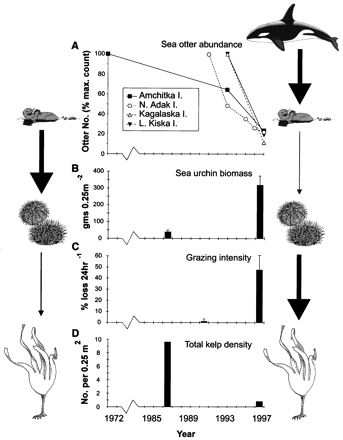
Figure 1 from Estes et al. 1998. " (A) Changes in sea otter abundance over time at several islands in the Aleutian archipelago and concurrent changes in (B) sea urchin biomass, (C) grazing intensity, and (D) kelp density measured from kelp forests at Adak Island. Error bars in (B) and (C) indicate 1 SE. The proposed mechanisms of change are portrayed in the marginal cartoons—the one on the left shows how the kelp forest ecosystem was organized before the sea otter's decline and the one on the right shows how this ecosystem changed with the addition of killer whales as an apex predator. Heavy arrows represent strong trophic interactions; light arrows represent weak interactions."

A similar trophic cascade involving sharks was reported in Myers et al. 2007, though these conclusions are still considered controversial among the scientific community. According to this paper, in the Outer Banks, a decrease in shark populations led to an increase in the populations of these sharks’ prey (including cownose rays), and increased cownose ray populations led to a decrease in their prey (including scallops, which used to be the basis for an important coastal fishery).
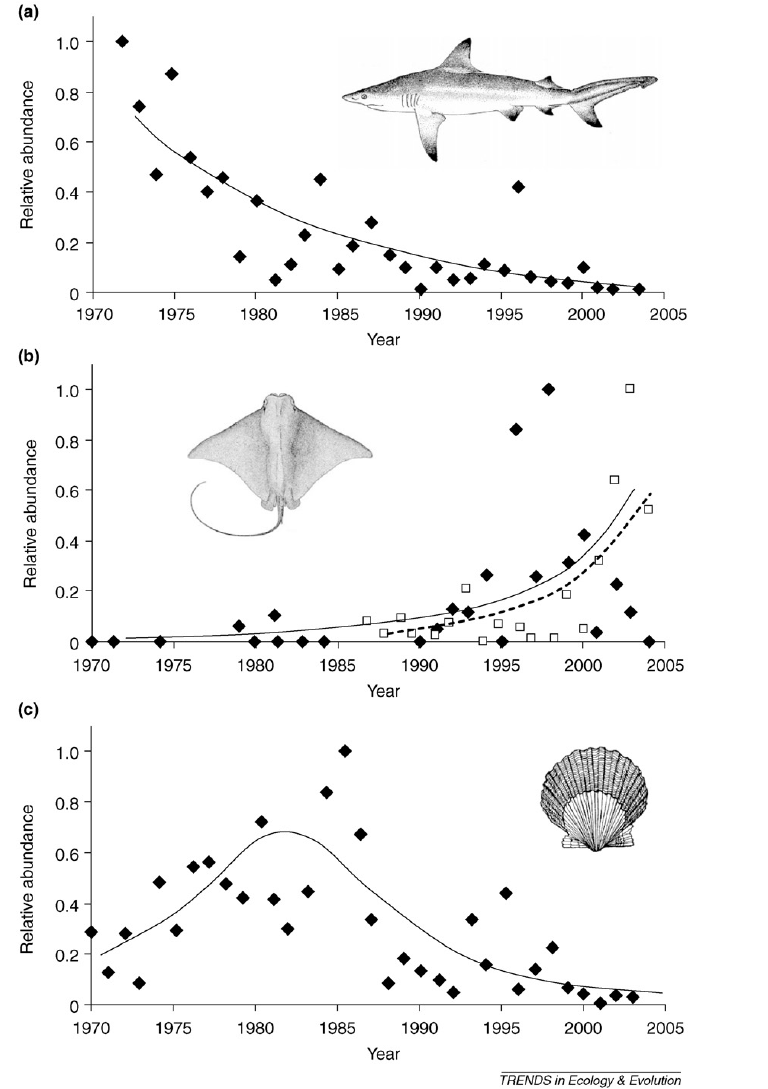
Figure 1 from Heithaus et al. 2008, a review of shark ecosystem effects, referencing the Myers et al. 2007 conclusions. "The removal of marine predators can result in cascading effects through communities. As (a) catch rates of large sharks, such as blacktip sharks (Carcharhinus limbatus), declined during research surveys along the east coast of the United States, (b) cownose rays began to increase, leading to eventual declines in (c) catches of North Carolina bay scallops (Agropecten irradians). Population densities are expressed as proportions of the observed time series maximum. Trend lines are best fits from generalized linear (a,b) or additive models (c). In (b), filled symbols and line denote Delaware Bay surveys, and open symbols and dashed line are Pamlico Sound, NC, surveys. Field experiments confirmed that scallop declines resulted from increased ray predation [5

There have been numerous models and observational studies concerning the ecological effects that would result from the loss of apex predators (a partial list can be found in my sources below). Not a single one mentions even the remote possibility of a decline in the global supply of oxygen as a consequence of overfishing sharks. If you encounter someone promoting this (or any of a huge variety of pseudoscience claiming to be based on real science), ask them for a copy of the peer-reviewed scientific paper which supports it.

Technically speaking, just because no one has ever written about this phenomenon applying to sharks doesn’t, in of itself, mean that it doesn’t apply to sharks. However, there’s a very good reason why the loss of sharks won’t affect phytoplankton. Trophic cascades tend to occur in simple ecosystems. In the kelp forest, basically only one type of organism eats kelp from the base (sea urchins) and basically only one type of organism eats sea urchins (otters). Sharks fit into different ecosystems differently, and many of those ecosystem are quite complex, so the claim that the loss of sharks will have a uniform global effect is inaccurate at best.

Research from coral reef ecosystems shows than when predator/prey interactions are more diffuse (for example, a system might have many herbivores, many secondary consumers, etc.) , trophic cascades don’t occur. Sharks may eat some herbivores, but they also eat animals that eat those herbivores, so the ecological effects would be less direct. Additionally, even if one prey species experiences “predation release”, other species with similar ecological niches are not affected in the same way. In a complex ecosystem, sharks can be considered to be “trophically decoupled” from phytoplankton- their populations will not affect those of phytoplankton because the trophic relationships are diffuse and complex. Most marine ecosystems are quite complex, as seen below:
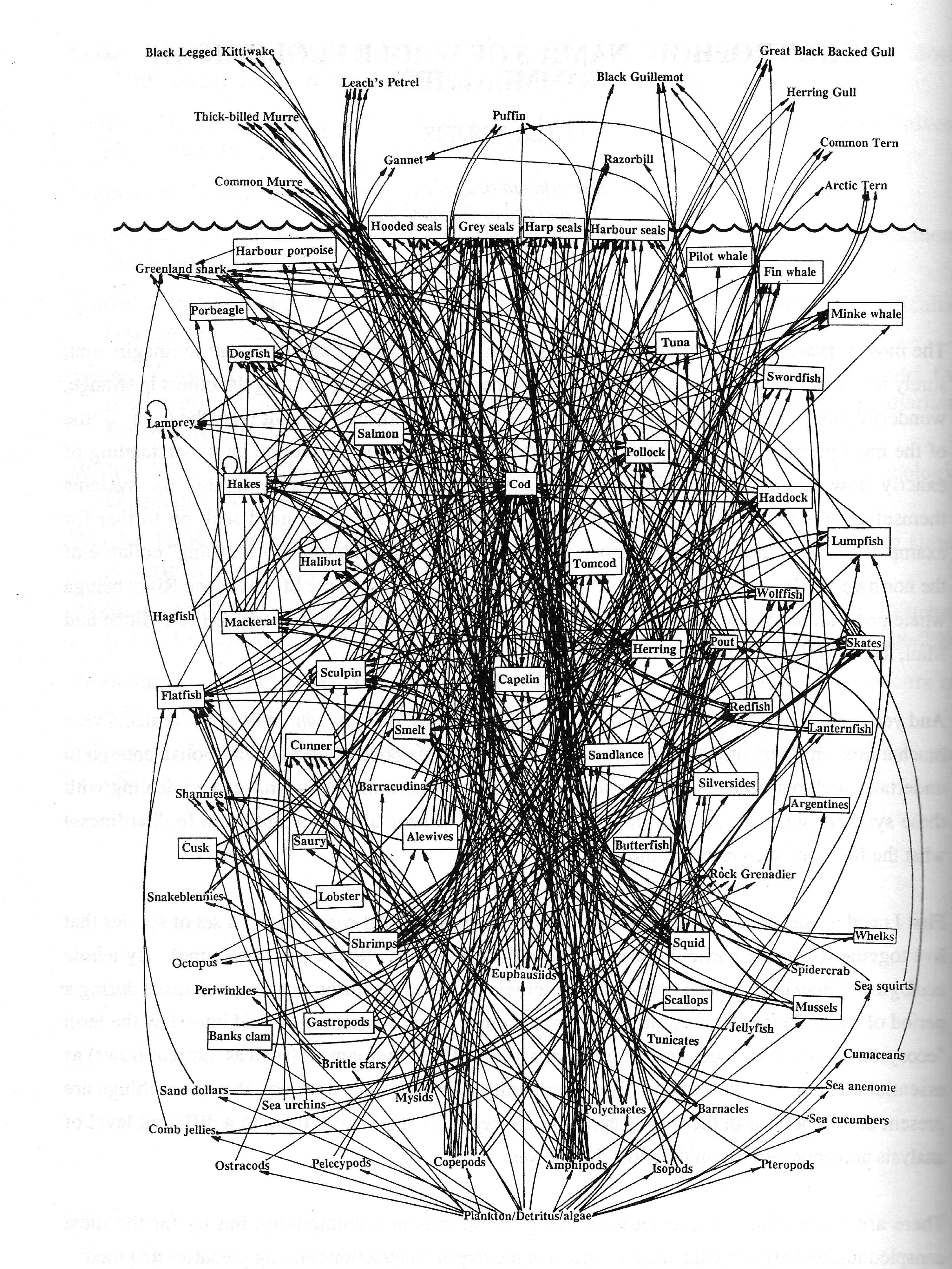
A cod-based food web in the North Atlantic, a region of the ocean with relatively FEW species. Image from David Lavigne, National Science and Engineering Research Council

In fact, emerging research in the field of fear ecology has shown that the most important effects resulting from the loss of sharks in an ecosystem may actually be indirect and related to behavior rather than population structure. In other words, sharks may exert more of an influence on an ecosystem by causing organisms in that system to alter their behavior to avoid being eaten. A great example of this comes from Dr. Mike Heithaus’ work in Australia. He found that animals like dolphins, sea turtles, and dugongs (relatives of manatees) will alter their preferred foraging ground during times of the year when large tiger sharks are present. They will forage in areas with less food but less chance of encountering a tiger shark.
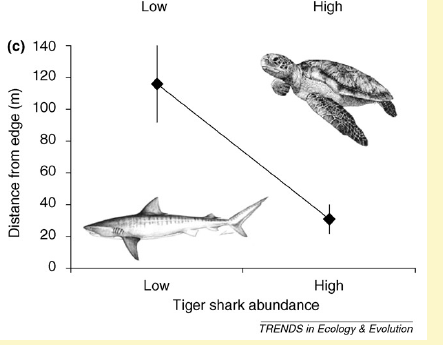
Figure 2 from Heithaus et al. 2008. "Risk effects of tiger sharks on megagrazers in Shark Bay, Australia....Green turtles in good body condition (assumed to indicate a good energy state) shift to safe microhabitats with nutrient-poor seagrass when sharks are common"

Many species of sharks have been dangerously overharvested, resulting in alarmingly rapid and severe population declines. The loss of sharks can result in disruptions to the food web, resulting in ecological (and in many cases economic) problems. Conservationists are correct to be concerned about the loss of sharks and the effects this will have on our oceans, and we can and should work to protect these animals. However, sharks have absolutely nothing whatsoever to do with the global oxygen supply. There is absolutely no evidence in favor of this claim, and lots of evidence against it.

Spreading inaccurate claims in support of a worthy cause can only harm that cause by reducing credibility with the public and with policymakers. There are enough real reasons to protect sharks that we shouldn’t need to make up nonsense with no factual basis. I call on all responsible conservationists and advocates to stop perpetuating this pseudoscience.

Source: Southern Fried Science

Thursday, December 29, 2011

New Deep Water Shark Species: CA research team finds 4 new sharks off African coast

When I am called upon to speak about sharks and shark conservation, I often mention how many different species of shark there are. People initially think of the larger, more iconic species, but there are approximately 360+ and the plus sign at the end of that number keeps growing seemingly every day.

The San Francisco-based California Academy of Sciences recently completed an expedition into the deep depths off Mozambique and came up with 4 new species of shark along with a long list of new invertebrates, fish, plants, and other marine critters. Mozambique lies along the southeastern coast of Africa, with the island of Madagascar to the east. The researchers were trawling along deep canyons in depths ranging from 1,500 feet to 3,000 feet deep.

This past summer, the academy conducted a marine biodiversity expedition off the Philippines and came across deep water species of swell shark. These are small sharks that are able to gulp seawater to expand or "swell" which either makes them look more menacing to potential predators or enables them to wedge themselves in rocky crevices for protection. At home in California waters, I have come across our local swell shark species and, if gently trying to coax them out into the open for a better look, have seen them swell up. At that point they're safe from curious divers as it would take a crowbar and a couple of sticks of dynamite to dislodge them (certainly not something I advocate).

Back in Mozambique, the Academy researchers also came across two new species of lantern shark which are capable of producing light at various points on their bodies in the dark depths. Scientists suspect that light-emitting sea creatures utilize this bioluminescent ability to both attract members of their own species and provide camouflage from predators. (Where the lights are placed can confuse a predator in thinking a tail is where a head should be, so their prey zigs when they thought it would zag.) Sadly, one of the lantern shark specimens was identified in a Taiwan fish market which means that commercial fisherman are dropping nets deeper and deeper in search of fish to fill their holds.

Another new shark discovered was a type of angel shark, basically a bottom dweller with wide pectoral fins that give the angel shark a very stingray or guitarfish-like appearance. The angel sharks coloration allows it to blend in with the bottom, much like other bottom-dwelling ambush predators including flounder and halibut. When I first began diving - meaning when I was young and dumb - I used to come across angel sharks at the base of Ship Rock off Southern California's Catalina Island. I would approach these sharks strewned across the bottom and slowly lift their tails just to see them suddenly dash off. But everything once in a while, one would turn around and race towards me, obviously annoyed and looking for trouble. Told ya' - young and dumb.

The California Academy of Sciences' most unusual find was an African dwarf sawshark or sawfish, brought up from around 1,600 feet. Though considerably smaller than most species of sawshark, this particular shark uses its "saw" or rostrum in much the same way as its larger cousins. Whipping it quickly from side to side, the shark stuns and wounds smaller fish, enabling it to easily feed on the wounded fish.

At the Aquarium of the Pacific in Long Beach, California, they have had a large sawshark on display in their Shark Lagoon exhibit for many years. It coexists with larger sand tiger sharks and rays, but every once in a while a curious smaller shark, like a blacktip reef shark, will forget his or her place, crowd the sawshark and get a little taste of sawshark hospitality. I've had the opportunity to film the Aquarium's saw shark and document their staff giving a blacktip shark a stitch or two. No great harm done and believe me, the blacktips learn fast.

The more research that takes place, the more it brings new species to light (This one expedition to Mozambique produced 33 scientific papers alone). In fact, David Ebert, a research associate at the Academy, said that about 200 new sharks and rays have been discovered in just the past decade, whereas close to the same number were identified in the previous three decades combined. So much for the idea of 360 species of sharks. I'll need to amend my notes. . .

Today, using submersibles and ROVs (remotely operated vehicles), scientists are finding more and more unusual creatures that have evolved and adapted to the harsh living conditions found in deep water. However, as remote and seemingly isolated as these animals may appear to be, they and the marine environment they call home are very much connected to the swallower waters that we may be more familiar with. It's one ocean and one incredibly complex, interwoven environment.


"A lot of [shark] species are going under the radar because they're not as high profile,"said David Ebert, referring to well-known sharks like the great white. "There's a lot out there in the big ocean we don't know anything about."

Source: National Geographic Daily News
Source: Deeper Blue
Source: Live Science

Wednesday, December 28, 2011

Orcas vs. Sharks: whales hunt deep sea sharks in New Zealand

Thought I would pass along this interesting blog post from marine biologist Candace Calloway Whiting, writing in the Seattle PI. She did some digging in regards to a recent event documented in New Zealand of pod of orcas corralling what appear to be some juvenile cowsharks (six- or seven-gill) in a sort of hunting/feeding technique.

Orcas have been known to prey upon sharks, but what makes this news item so noteworthy is that these New Zealand orcas were after deep water sharks and that they managed to bring them to the surface, disorienting the sharks which played to the orcas' advantage. It also appears that the orcas were able to capitalize on the fact that these sharks will stick together - brothers and sisters - which is not a common shark behavior.

Pod of Orcas Rounds Up a Group of Sharks - Were These Sharks Related to Each Other?

Update: 12/28/11 - In reply to my request to identify the shark species involved, Seattle Aquarium shark biologist Jeff Christiansen sent the following :

"It is difficult to make a definitive ID from a partial view and with only one photo but I would hazard a guess the shark in the photo is a sevengill shark Notorynchus cepedianus or possibly even Heptranchias perlo. While I can’t rule out a sixgill the spotting pattern visible on the dorsal surface of the shark is characteristic of the sevengill. The photo is not sharp enough to tell if there are six or seven gill slits. Its definitely one of the Cowsharks as the six and sevengill sharks are called and finding them in groups is not unusual for that species… pack hunting and association is documented in sevengills. The Sevengill can tolerate much higher light levels than its deep water cousin the sixgill."

I’ll update again when I hear back from a New Zealand orca researcher who may have more information on the orca pod that appeared to be hunting the sharks.

On Boxing Day (the day after Christmas) in New Zealand a pod of orcas managed to corral at least a half dozen sharks and apparently gave them a good thrashing in the shallows off the beach. Orcas are known to kill and eat sharks in many parts of their range – often eating the nutrient dense livers and discarding the rest – so although witnessing the interaction must have been amazing, the news that the whales went after the sharks was in and of itself not surprising.

But the fact that the orcas managed to get several sharks together in a group for the presumed mayhem is fairly astounding, and I was as curious about the sharks as I was the orcas as I read the article.

Copyright protection prohibits me from being able to use the photo of one of the sharks thought to have been involved in the altercation with the orcas, but it is similar to this one, and is one of the few species that is easily identified with just a head shot. If you look carefully you will see that the shark has six gills [note update above, this may have been a related species of cowshark, not a sixgill] instead of the usual five, and logically is called a six-gill shark (the sixth gill is thought to help extract oxygen from the deep water where the adult sharks are found).

The following video shows both the massive size this species can attain, and the depth to which it can be found. “This six-gill shark (Hexanchus) was filmed during a submersible dive off the northeast coast of Molokai at a depth of 1000m (3280ft). The 2 red laser dots are 6 inches apart, resulting in a length of about 18 ft for the shark.”


But if they were chasing this deep sea species of shark, how did the orcas manage to get several, albeit smaller, of these sharks rounded up in the shallows off the beach?

I found the answer through the Seattle Aquarium’s shark research program, and though I have not gotten a confirmation that this is the shark species involved in the New Zealand fracas, what I learned about six-gill sharks is fascinating and over-turns much of what we believe to be true about sharks in general.

The biologists have discovered that in this local population, sibling six-gill sharks stay together for many years, at least until they become large enough to move out of the protected environment of the Salish Sea.

The mother shark can give birth to over 100 baby sharks (called pups), and each litter of brothers and sisters remains together for years in “loosely associated groups”, possibly finding food together and avoiding predators.

The eyes of six-gill sharks are adapted to low light conditions and they shun the bright light of the surface during daylight hours, so the orcas might have managed to find a group of the sharks in deeper water, driven them to the surface where the sharks would have been blinded and disoriented causing them to swim up onto the beach (the news article reported that observers thought the sharks swam up to get out of the water, certainly possible but not likely.)

Although six-gill sharks are opportunistic feeders often scavenging about anything they can find, humans are not on the menu, and fortunately for them these sharks aren’t usually on our menu either – what a shame it would be to kill off the sharks of the world without ever knowing their secrets.

Brother and sister sharks growing up together, who knew?

For more on orcas and sharks, please see “Orcas and sharks, just who is hunting whom?” Also this report on New Zealand orca expert Ingrid Visser’s discovery of orcas hunting thresher sharks.

Source: SeattlePI.com
Source: Stuff.co.nz

Saturday, December 17, 2011

Egypt's Endangered Sharks: Arab Spring had unintended consequence for conservation

It's been quite a few years since the week I spent diving in the northern Red Sea. Staying on a live-aboard dive boat, I had the chance to see corals that in many ways have remained unsurpassed to me ever since. The reef fish were quite abundant while, in more open water, most sharks were skittish and kept their distance, except for my first close-up encounter with a large nurse shark that was only interested in resting undisturbed on the sandy bottom.

However, according to the Egypt Independent, the Red Sea's geography that positions it as an almost completely closed body of water (open naturally in the south at the Ba-el-Mandeb Strait and in the north at the man-made Suez Canal) has not isolated it from the same problems that befall sharks throughout the rest of the world's oceans: Egypt's sharks are endangered.

Amr Ali, managing director of the Hurghada Environmental Protection and Conservation Association (HEPCA) , claims that the populations of hammerhead, oceanic whitetip, and other sharks species have declined by as much as 80 percent, and for much the same reason as is found in other oceans.

“Over the years we’ve had many different cases of illegal fishing in the Red Sea,” said Ali. "Five years ago there was a big issue with Chinese poachers; last year it was the Yemenis. It is certainly by far the main reason behind the sharp decline.”

With iconic pyramids and many other ancient locations to visit and artifacts to see, Egypt has a large and lucrative tourism industry to protect. Because of that, the economic value in tourisim dollars for a living shark as opposed to a dead one is not lost on Egyptian officials. But they have been slow to respond to the overfishing or illegal fishing of sharks because they consider what shark fishing brings to lower-income local fisherman and because there has not been a convincing amount of study done in the Red Sea on shark populations.

Reported in the Egypt Independent, "
Relying on the Egyptian Environmental Affairs Agency (EEAA) is useless, says Ali. 'So our role, if we’re serious about preventing declining populations, has to be a very active one.' In 2006, the HEPCA obtained two decrees from the Red Sea governor banning fishing for and trading sharks. Getting caught with a shark illegally resulted in severe penalties."

Encouraging, but with the coming of the Arab Spring in December of last year, the law enforcement infrastructures for many countries bordering the Red Sea weakened and with that, illegal shark fishing has increased dramatically. Government resources and priorities are being drawn elsewhere and, while the demise of dictatorships and oppressive governments are being welcomed as good news by major developed countries and Arab citizens alike, an unintended consequence has been a loss of environmental protections.

“The [army] coast guards used to fend off poachers which really helped,” Amr Ali observed. “But with them gone, it’s impossible for us or other NGOs to monitor 160km of coast.”

To help make a compelling case for shark protection - strong enough to once again make it a government priority - scientists will need to conduct more research. An overwhelming body of facts combined with a thorough explanation of the consequences of doing nothing (the trophic cascade effect that can occur when top predators like sharks are removed from the ecosystem) is what is needed for government officials to realize the magnitude of the problem and how the short-term gain for local fishermen is far outweighed by the long-term negative impact on the entire Red Sea ocean community and, by extension, on the local fishermen as well.

Mexican researchers faced this same problem in the early 2000's when they sought protections for several species of sharks and rays. The Mexican government wanted data - a lot of it. And so years of tagging and tracking studies were engaged until the evidence was indisputable. When I first met Mauricio Hoyos Ph.D. in 2005, the then graduate student was tagging and tracking great white sharks at Isla Guadalupe for just that purpose. And he continues to tag and monitor white sharks to this day.

In Egypt, HEPCA intends to embark on an extensive tagging study in 2012, along with developing a database of shark fin species and location identification, using DNA from the fins, to compile the data needed to make a case for renewed and more aggressive conservation measures.

Amr Ali said, “Once these studies are done, we’ll hopefully be able to create a proper science for shark conservation in Egypt.”

Let's hope so. I still consider the Red Sea as one of my all-time favorite dive locations even though I was there just the one time - that's how impressed I was with the beauty and biodiversity of this unique body of water. Without sharks, it stands to suffer greatly.

Source: Egypt Independent.

Saturday, October 29, 2011

Shark Conservation: CNN reports on sharks, their supporters and going shark-free

As a follow up to my Thursday post on CNN's report on ocean plastic pollution to air this Sunday, October 30th at 5pm and 8pm, also in the same program will be a segment on sharks and shark conservation efforts: Sharks: from predators to prey.

The segment will cover many of the issues that shark advocates have been promoting for several years, but it always bears repeating. Overfishing from commercial shark fishing operations, the high demand in Asian countries for shark products - particularly shark fins - and the critical role that sharks play as apex predators in maintaining a healthy and well-balanced marine ecosystem. These are the facts. Over-sensationalism, like rampaging sharks on the attack for humans at any opportunity, is what fuels misconceptions and provides fodder for a media looking for a quick headline. However, for the most part, CNN has done a pretty responsible job in putting forth the truth about sharks and the threats they face. So, kudos to the folks in Atlanta.

The shark segment on CNN this Sunday also looks at the Shark Free Marinas Initiative (SFMI) and its director, marine biologist Luke Tipple. Luke is a good friend and I've had the opportunity to capture him on film many times both above and below the waves, diving in open water with white sharks, tigers, and others, or talking about sharks and the Shark Free Marinas Initiative.

With location services set up by SharkDivers.com, CNN spent time with Luke in the Grand Bahamas where SFMI has a foothold with one of the island's most popular marinas catering to sportfishermen. Compared to commercial operations, the number of sharks taken by recreational sportfishermen is much smaller but at this stage of the game, the loss of any shark is a blow to the species' population.
Recreational shark fishing tournaments are still being held each year and draw considerable worldwide criticism from conservation groups like The Humane Society - which supports SFMI. But when sportfishermen either opt for catch-and-release of sharks or choose not to catch them altogether, it can have an impact on an influential segment of the ocean-going public that can spread.

Here's a video preview of the CNN news report:


CNN's Sharks: from predator to prey airs Sunday, Oct. 30th at 5pm & 8pm PST (8 & 11pm EST) on CNN.
Learn about the Shark Free Marinas Initiative.

Saturday, October 8, 2011

A Week for Sharks: CA shark fin ban is now law, Australia concerned over shark diving

It's been a week for sharks, particularly in California. Governor Jerry Brown signed AB 376 into law which bans the trade and possession of shark fins in California. This was a critical piece in a mosaic of shark fin distribution in the northern Pacific ocean.

As reported by COARE (Center for Oceanic Awareness Research and Education), "California's ban complements bans in place in Hawaii, Washington, and Oregon, effectively shutting the west coast of the United States to fin traders. It is estimated that the United States is responsible for 70% of the world's fin imports outside of Asia. With a staggering 85% of those U.S.-bound fins passing through California, AB 376 will have a tremendous impact on shark conservation."

Now we must watch for where the next distribution hubs will appear - there's too much at stake financially for some of these shark fin distributors to simply throw in the towel. And there is also the concern over illegal activities.

But the tide does seem to be turning and other nations are considering tighter regulations or out right bans on shark products. My personal concern is that, for some of the general public, sharks have become the cause d'jour and while there are some hard working advocates who, I am sure, will keep the fires burning for more conservation and regulation, I worry that the general public might tire of the cause - in today's Information Age, attention spans can dry up in the blink of an eye - and without public support, commercial shark fishing lobbyists and business representatives will jump on the opportunity to sway politicians in their favor. Only time will tell.

"The world has been watching and waiting. With similar efforts underway in parts of Canada, and with a ban proposed in China, California's efforts hopefully will ripple into many other places," said COARE.

However, one avenue whereby people can appreciate sharks up close in the wild may soon be curtailed or at least limited. Australia is one of three or four primary locations in the world where people can cage dive to view great white sharks. But Australia's ABC News reports that there
are new findings that white sharks are staying in close to coastal areas, where they are often baited for the shark diving operators, and anecdotal reports of an increased number of shark/surfer encounters has some saying that the number of operators should be halved from four to two and that the number of days in which they can chum for sharks should also be reduced. (Click image to view video.)

There have been studies, both in Australia and Hawaii, that show that the sharks' response to chumming over a given period is a transitory behavior and does not equate into 1.) a significant change in the shark's normal feeding behavior and 2.) that the sharks do not equate the boat-supplied food with humans. However, some thought should be given to the fact that in Australia, they are currently chumming for white sharks as much as 270 days a year - double that of just a few years ago.

On a personal note, today I am leaving for San Diego, California to embark on my seventeenth trip to Isla Guadalupe off the coast of Baja, Mexico, compliments of Shark Diver. Isla Guadalupe is one of the world's premier sites for viewing great white sharks. A population migrates to the
island in the fall months and though Mexican government regulations have greatly scaled back any baiting of the sharks, there are still plenty of encounters to keep the cage-bound divers thrilled and satisfied. I will be accompanying my friend and photojournalist, Budd Riker on his inaugural trip as he takes notes and pictures for a future photo magazine article.

While some zealous Mexican conservation groups have expressed concern that the shark diving operators at Isla Guadalupe have, over the years, disrupted the normal behavior of these sharks; in the seven years that I have been coming to the island I have yet to see any evidence or reason for concern. When the sharks were more vigorously chummed and baited in the past, the sum total of what they consumed was a mere drop in the bucket compared to the normal requirements for their diet which, for adults, consists of primarily seals and sea lions. And as the sharks would inhabit the waters around Isla Guadalupe for just three to four months, it is reasonable to assume that they didn't spend the next eight months wasting away, waiting for when they would return to Mexican waters for some leftover fish parts.

So, I will be heading out in just a few minutes and will post a follow up when I get back in a few days. In the meantime, shark advocates, no time to rest on our California legislation laurels. There's still more work to be done.

Sunday, October 2, 2011

PETA on Sharks: hotly contested billboard reinforces stereotypes

During the course of writing this blog over the past couple of years, many of my readers have come to appreciate a certain civility and thoughtfulness that I try to bring to my work. It's obvious by the subjects that I discuss that I am pro-conservation, pro-ocean, and pro-shark to name a few, but I rarely engage in rude put-downs or coarse language.

But PETA's latest billboard campaign truly tests my resolve. By showing a human leg dangling from the jaws of a white shark with the headline, "Payback is hell," this pro-animal rights group sets public awareness and support back a few notches by reinforcing stereotypes of the shark as mindless killers. Or actually, not mindless at all but cunning and vengeful - right out of a bad Jaws sequel.

Though PETA (People for the Ethical Treatment of Animals) spouts some obligatory quotes about humans being the ultimate predator, not sharks; their real message is an anti-meat, pro-vegan position - which is fine to express but not at the expense of one of the very animals you claim to be protecting.

They may have thought, "Oh, people will get it. It's just a shark, just a picture." Well, in a world where American presidents have their nationality and their patriotism questioned, where climate change is expected to be cured by prayer, and where fallen soldiers are called "faggots" and said to have deserved to die; it's not all that hard to imagine many people viewing the PETA billboard and confirming to themselves that sharks are selecting humans for attack and therefore do not need our protection or concern - proof that the only good shark is a dead shark.

There have been many who have been assaulting PETA for this billboard and their stated rationale (as a follow up advertisement to a recent shark bite incident near the Gulf of Mexico.)

"With the recent shark attack in the news, we thought that it was a good time to bring this discussion up that will hopefully save lives, both human and animals," PETA Campaign Manager Ashley Byrne told The Huffington Post. "Sharks are not the most dangerous predators on Earth, we are. Americans alone kill billions of animals for food every year, including fish. And while sharks are natural carnivores, people can choose what they eat."

That's right, Ms. Byrne, sharks are natural predators, feeding on a wide range of animals which, in turn, helps to maintain a healthy and balanced ecosystem. And with their continuing loss through commercial fishing, that balance is quickly being thrown out of whack. But the 50 injuries and 5 fatalities that people experience from sharks on average each year are not the result of a concerted campaign of retaliation, as your billboard moronically implies.

Shame on you. If you feel you need to promote such a ludicrous statement to support your cause, then I suggest you rethink your cause. People can be fooled with misleading images and headlines and so, because of that, it is incumbent on anyone who believes a cause to be righteous to deal in truth always.

"Payback is hell." It's stupid, lame, misleading and basically just a flat out lie. And it's serious, not intended as humor or satire - so we will take it as the serious statement that it is and I along with many of my conservation and shark advocate colleagues will choose not to ignore but to soundly repudiate it.


If you wish to express your views to PETA regarding the billboard, you may fill-out an online message form at the Peta website. Click here.

Sunday, September 25, 2011

Hong Kong Shark Foundation: taking shark advocacy to the streets of Hong Kong

Shark conservation has grown over the years with some quantifiable progress in the form of legislation, regulations, and defined sanctuaries. There has been some improvement in advocacy and general public awareness. But there has also has been time, energy, and needed funds wasted over perhaps well-intended feel good campaigns whose results did nothing to move the needle in the direction of improved conservation.

Actually, that can probably be said of all conservation movements and so it is incumbent upon all of us who are interested in conservation issues to study the players and make sure that our efforts and support are directed to those groups who can bring about real change.

Regarding the issue of market demand in Asian countries for shark fin products, I was encouraged to see this small news item by the Associated Foreign Press and picked up far to the west in the Oman Daily Observer: a "plankmob" in the streets of of downtown Hong Kong to protest shark fins and shark fin soup. The event was planned for today, Sunday, by the Hong Kong Shark Foundation - an organization dedicated to conserving sharks and situated in the midst of one of the major trade centers for shark products.

"Supporters of the Hong Kong Shark Foundation march along a street to raise awareness for sharks killed each year for their fins, in Hong Kong yesterday. According to studies of the shark fin market up to 73 million sharks are killed each year, primarily for their fins used in shark fin soup. A bowl of shark fin soup can cost 100 USD, with a single fin being worth more than 1,300 USD."

Read about the Hong Kong Shark Foundation.

Monday, September 5, 2011

Demon Fish: an A to Z look at sharks and the world surrounding them

The summer has come to a close, Discovery's Shark Week has passed, sightings and shark incidents have once again brought out the "Summer of the Shark" hyperbole and so now, as the seas begin to calm, it's time for some well-written, intellectual discourse on the subject.

If one is interested in learning about sharks, there are quite a few books available - just do a search on your favorite online book retailer and you'll find a vast selection to choose from. There are many stunning picture or coffee table editions from which you can appreciate the variety of sharks. And there are some good informational books, many of which churn over the same information - almost a common vocabulary or library of factoids. It can be interesting to review some of these books based on when they were written; there's much that we keep learning about sharks so the science is continually being re-written.

However, I don't believe there has been a definitive volume that looks at not only the well-worn facts, but also the culture, the history of man's relationship with the shark and how that effects our past, present, and future attitudes - all of which play a hand in the shark's future and our own. No such volume existed until now, with the publication of Demon Fish by Juliet Eilperin (Pantheon Books).

Subtiltled Travels Through the Hidden World of Sharks, Demon Fish represents several years of study by Ms. Eilperin into both the role of sharks within the marine ecosystem and the role it has played in our society. The reader experiences the big picture and the many players involved, from scientists to sportfishermen to commercial shark traders to island natives to worldwide conservation groups. Eilperin weaves these all together into a tapestry of interconnectivity: many may fear the shark, but it has been a part of our lives for centuries.

As the national environmental reporter for The Washington Post, Eilperin is the consummate journalist, digging deep for details, providing the background to put people, places, and events into context. For some who may be looking for a wild adventure yarn, there may be more detail here than desired. But to take a pass would be a shame. Demon Fish takes you into the world of the shark and the world that surrounds it. If sharks are to succeed as a species, we must understand and appreciate both worlds.

Eilperin writes of the many scientists, shark advocates, and conservation organizations that are working to both understand and protect sharks. Names like Peter Klimley, Robert Hueter, Neil Hammerschlag, Mahmood Shivjii, Barbara Block, South Africa's Alison Kock, and many others from around the world - some well-known in shark advocate circles, some perhaps not - all have their work highlighted to show what we are learning about sharks, how important they are to maintaining a healthy ocean, and why many of them are become scientist-activists as they reaffirm that the greater predator - the true villain in this aquatic play - is humankind itself.

However, even though Eilperin's pro-shark position is clear throughout the book, as a seasoned impartial journalist she also delves into the lives and the minds of those who we might think of as some of the shark's greatest adversaries: commercial shark traders, sport or commercial fishermen, and indifferent or anti-shark cultural attitudes particularly in Asia. This is an aspect of Demon Fish that I believe sets it apart from all the rest. From avid shark hunters like "Mark the Shark" Quartiano, who runs shark fishing charters out of Florida, to Yip Chiu Sung, a major Hong Kong trader in shark products, Eilperin's interviews and observations paint a complete portrait of those who view sharks as a commodity or as a demon that needs to be destroyed.

For many of today's fervent shark advocates, having this backstory view of those who they would prefer to condemn is critically important as more and more legislation and regulations are being proposed worldwide to protect sharks. In today's political world, the success of such policies will depend on strategies that can convince and win over those who view sharks more in economic rather than ecological terms. Demon Fish allows us to know our enemies just as much as our heroes.

Centuries ago, many cultures respected and even worshiped sharks - some island nations still do. But for the most part there was a cultural shift that propagated fear and ignorance. It has taken time, but those attitudes are now wreaking havoc on an entire species. Meticulously written, Juliet Eilperin's Demon Fish comes closest to being the alpha/omega examination on how we got to where we are today, what's being done, and what may lie ahead.

Sunday, August 28, 2011

Filmmaker's Journal: one of Bahama's groupers comes to play

The last time I was in the Bahamas this past spring, I was there aboard Blue Iguana Charters' MV Kate to film sharks . . . again. Not that I ever get tired filming those incredible animals but, after all, variety is the spice of life, right? That's what makes the Bahama's so much fun and Capt. Scotty Gray knows how to pack a lot into one trip: sharks, wreck diving, dolphins, and beautiful reefs.


Here's a quick video that briefly shows some of the shark fun the Bahamas are famous for, but also highlights a great encounter that crew member Rob MacDonald and I had with a large grouper. Groupers are popular gamefish with Florida sportfishermen and that's unfortunate because their numbers have declined - just when the marine ecosystem needs them most. With the explosion in the past few years in the number of lionfish, a beautiful but voracious reef fish that is an invasive species to the Caribbean, the grouper is one of only a few large predators that can potentially help keep the lionfish population in check, if only the grouper population itself was in better shape.


The grouper that visited Rob and I was initially interested in our bait crate, which contained some slabs of fish to attract Caribbean reef sharks. The reef sharks knew who was boss and you'll see one dart out of the grouper's way, as groupers are not afraid to butt heads with a shark if need be. With no easy meal available, the grouper proceeded to act like a cat weaving between our legs looking for a good petting. Actually more of a back scratching, as these large fish will attract small, pesky parasites and the grouper won't shy away from an opportunity to dislodge some of these hitchhikers.


The grouper continued to pass back and forth between the two of us for a good five to ten minutes. Then Rob pulled out a hunk of fish from the crate as a thank you to the grouper for spending time with us. And with that, it was on its way.


It's always a treat when you have the chance to safely interact with large animals. Sometimes it takes a few minutes to size up the animal's behavior to ensure, as best you can, that you won't be harassed or bitten. There's always that thought: "I wonder if this big fella is looking for some payback for all the relatives we humans have pulled out of the sea?"


Wednesday, August 24, 2011

Catching a Shark: marine laboratory to study effects of catch-and-release

In many parts of the world sportfishing is big business - there's no getting around it. And so whether you support or are opposed to the practice, it will probably be around for some time as long as there is money to made.


But it can be altered to provide for greater survivability of the fish through catch-and-release techniques. For conservationists, this isn't an ideal solution by any means. Dr. Sylvia Earle refers to catch-and-release as "torture and release" and to a large extant she has a point. Catching any fish by hook causes stress on the animal. After all, it was swimming and feeding one moment and the next, it's in complete survival mode fighting against some unknown force and slowly reaching a state of total exhaustion before being momentarily manhandled and then once again free to roam.


So, one way to look at catch-and-release is that it is an incremental step, one foot forward towards a greater awareness as to the sustainability and current dwindling populations of, in particular, large species like billfish and sharks. That is part of the philosophy behind the Shark Free Marinas Initiative (SFMI), supported by The Humane Society of America and the Guy Harvey Ocean Foundation. This organization gets sportfishing marinas to sign up to be "shark free" - meaning no sharks can be brought in to their docks for weighing, trophy photos, butchering, anything. No sharks, period.


Sure, to us hard core conservationists it would be great if all sportfishermen abandoned their rods and reels but, again, the economic underpinnings make it very unlikely that state or local governments will pass the required regulations that would effectively outlaw the sport. In California, legislation to prohibit the possession, trade, and distribution of shark fins is preparing for a final vote in the state senate. Those who oppose the legislation, AB 376, are pushing their campaign for a series of crippling amendments not because they hate sharks or love shark finning but because they see considerable dollars and many jobs that will be lost with its passage. Those who favor the legislation must carefully hone their argument and keep in mind that it is not the moral position or even the environmental position that will likely sway the politicians; it will be the economic rationale. And in today's current economic mess, any talk of lost revenue or jobs will certainly catch a politician's interest.


But I digress. . .


If we concede that catch-and-release is at least one step back from the brink of destruction of a fish, it's not an unreasonable question to ask just how much of a step it really is. Just how traumatic is catch-and-release on, say, a shark? Are there any long-term effects? Does the animal survive for the moment but die some days or even weeks later due to complications?


To better understand the lingering effects of catch-and-release techniques, Florida's Mote Marine Laboratory will begin a one-year study on sharks, aided by a $192 million grant from the National Oceanic and Atmospheric Administration (NOAA). Assisted by the Florida Aquarium's Center for Conservation and the Massachusetts Division of Marine Fisheries, the study will enlist the services of several sportfishing charter boats and will focus primarily on the blacktip shark, a popular species for shark fishermen because it is known to put up a good fight and often leap out of the water - some of the same criteria that make billfish like marlin popular among sportfishermen.


“For the first time, we’ll take a magnifying glass to sharks’ behavior after release — for instance, we’ll look at how strongly they’re swimming after capture and whether they’re rolling or listing,” said project leader Dr. Nick Whitney, a staff scientist in Mote’s Center for Shark Research. “These measurements go way beyond ‘dead or alive.’ The vast majority of sharks may survive, but it’s important to know if their recovery time varies with different kinds of fishing gear. Our technique will yield new, hard data comparing standard J-hooks with circle hooks, which are designed to be safer for sharks.”


Scientists will enlist the use of accelerometers - the same little electrical devices that sense movement in your smartphone or handheld video game player - along with small data recorders to record the movements of a shark as it is released following a catch-and-release episode. Every flick of the shark's tail or tilt of its dorsal fin will be recorded. The devices will fall off the shark after a period of time and will be retrieved and analyzed to determine the shark's behavior after being caught. By understanding what is being inflicted upon the shark, either temporary or long-lasting, wildlife management agencies can then better determine how best to minimize the effects through regulations and the use of various types of fishing gear.


“The goal will be for the charter captains to use the same practices and gear that Florida anglers normally would, so we can compare the two hooks in a real-world setting and look at how they perform in relation to shark survival and behavior,” Whitney said.


Personally, I choose not to fish. As a diver I stopped spearfishing or taking game like lobster or abalone many, many years ago. But I realize that sportfishing is a popular activity and thriving business in areas like Florida, and that overly-efficient, but indiscriminate, commercial fishing probably poses a much greater threat to overall survivability for many ocean species. So, if I want to sit down with a sportfisherman and have a go at changing his mindset and his hobby, having the scientific facts, as this Mote Marine Laboratory study hopes to obtain, will give me some heft to my argument - and could just maybe help prevent me from getting punched in the nose.

Sunday, August 14, 2011

Post-Shark Week Progress: basking shark taggings and California's AB376

Now that Discovery Channel's Shark Week has concluded and the entertainment frenzy that surrounds it has subsided, we all can get back to some serious-minded steps in research and policy to advance our understanding and conservation of these animals. Here are a couple of recent developments:


Basking Shark Tagging in Monterey

With each new study on sharks, scientists learn a little more about the wonderful world of sharks, but there are still some species that are shrouded in mystery. Take the basking shark, the second largest of all sharks, next to the whale shark, and one not to be feared as it is a filter feeder like baleen whales.


Preferring cold water, the basking shark has been studied in the North Atlantic, but limited studies have taken place in the Pacific. The Pelagic Shark Research Foundation has just started a more detailed tagging program in and around Monterey Bay, CA, utilizing satellite tracking tags that have been successfully used on other species like great white sharks. To date, only basic number/color identification tags have been used. With the use of an archival satellite tag - which can store various position, depth, and speed data for later retrieval via satellite - the foundation can accumulate more detailed and accurate data as to the movements of basking sharks.


Sean Van Sommeran, founder and director of the Pelagic Shark Research Foundation, describes the basking shark as
"elusive" and, as they are recognized as threatened, are considered "commercially extinct."


Working in conjunction with Stanford University and the National Oceanic and Atmospheric Administration (NOAA), Van Sommeran's foundation has tagged one sub-adult basking shark at around 15 to 16 feet in length and plans to tag more.


California's AB376 Anti-Shark Fin Bill Advances

This Monday, California's Assembly Bill 376, which prohibits sale, possession, and distribution of shark fins - much like legislation already passed in Hawaii, Oregon, and Washington - will take the next step on its way to a final vote. The bill will go before the Senate Appropriations Committee and for many of the bill's supporters, the big issue here is whether there will be any amendments tacked on to the legislation that will weaken it and provide loopholes for commercial operations to continue.


You can support and participate in various efforts being staged by a variety of shark advocate groups - Sea Stewards, based in San Francisco, is planning a bus ride tomorrow to Sacramento to make a physical presence in support of AB376. However, one of the best ways to make your voice heard is through direct communication to the members of the committee. Sea Stewards has provided a listing of the members' email addresses and sample email content.


senator.kehoe@sen.ca.gov,

Senator.Alquist@SENATE.CA.GOV,

senator.runner@sen.ca.gov,

senator.price@sen.ca.gov,

senator.walters@sen.ca.gov,

senator.lieu@sen.ca.gov,

senator.alquist@sen.ca.gov,

Senator.Pavley@senate.ca.gov

Dear Senators,

I urge you to vote for AB 376 without amendments. Scientists have testified that the suggested amendment to allow shark fins from domestic fisheries cannot be enforced and will lead to increased fishing pressure on domestic sharks and allow black market fins to enter the market.

Also, the MSC certification of fins is not a viable option. To date there has not been a well managed and sustainable shark fishery. Focused shark fisheries lead to collapse of the population. Sharks are vital for ecosystem health.

For these reasons please support this bill as written.

sincerely,

There are some powerful forces at work in opposition to AB376 that have pulled out all the stops to amend, if not defeat the bill, using accusations of anti-Asian sentiments or lost commercial and state revenue. It's getting down to the wire and the lobbyists will be playing hardball on both sides. Let your sentiments be heard by the elected officials - oddly enough, in this world of ineffectual politics, it can make a difference.


Read about basking shark tagging in the
Santa Cruz Sentinel.

Read about AB376 and what you can do at SeaStewards.org.


Saturday, July 30, 2011

Man Bites Shark: a rational look at reports of increased shark encounters

For better or worse, this is the shark's time of year. Newspapers, magazines, television programming and news broadcast, and motion pictures - all forms of media jump on the bandwagon to herald the summer of the shark. Nearly one-third of my posts this month, so far, have been about sharks - and I wasn't even making a conscious choice to do so.

Fueling the annual fire this year about sharks - particularly any shark-human interactions - is the fact that there have been more human interactions with sharks. There are a multitude of reasons behind this, depending on the location and the shark species, but complex explanations are not the stuff of quick sound bites and hot-of-the-press headlines. However, without delving into the devilish details then people are left to fall back on simplistic reasons that plug into their primal curiosity mixed with fear of these animals: the number of sharks are growing; and they are out to get us.

And so, at the apex of the annual shark mania (or nadir, depending on your point of view), I present the calm, rational position statement - not from my hand but from The Washington Post's national environmental science write, Juliet Eilperin. Writing for Foreign Policy, Man Bites Shark is an overview of man's interaction with the shark world from the 1500s to today. It examines the reasons why more sharks, ranging from benign whale sharks to great white sharks, have been reported in the past few years, and why shark attacks increased by 25% in 2010.

In many respects, we are two species on a collision course. And the one steering the boat is mankind.

At first glance, sharks -- with their sharp jaws, torpedo-shaped bodies, and unusual sensing abilities -- appear to be bizarre vestiges of a distant past. But they can also tell us a lot about our present and our future. Where sharks appear in big numbers, coral reefs and other marine life around them thrive because they remove weak and sick animals from the system and can keep midlevel predators in check. When they shift their migrations, scientists often detect a shift in ocean temperatures and prey populations. For researchers seeking to create a more efficient electric battery, faster vessels, or a robot that can track oil and chemical spills underwater, sharks' sleek and extraordinarily efficient bodies offer inspiration for design. In countries where their fins end up at the dinner table, economists can generally find rising incomes. The animal humans fear most has become a global commodity, an economic indicator, and environmental harbinger of things to come.

In many ways, the movie character Matt Hooper was right on the money when he said, "All sharks want to do is swim, eat, and make little sharks." That can be said of almost every creature in the sea. It's mankind that has the multiple agendas that put us in touch with sharks, from tourism to fishing to research to storytelling.

In Man Bites Shark, Ms. Eilperin is the objective journalist, putting emotions aside - either pro-shark or anti-shark. Just the facts.

During the 20th century, the increase in shark attacks in Florida -- which leads the world in shark strikes almost every year -- closely tracked both the state's population rise and the number of people going to the beach, according to statistics compiled by the University of Florida's International Shark Attack File. In 1900, Florida's population stood at 530,000, and there was one unprovoked shark strike between 1900 and 1909; by 1950, the state had 2.77 million residents, and attacks that decade totaled 13; by 2000, when the population had soared to nearly 16 million, 256 shark strikes took place over the course of the decade.

Many of us familiar with sharks have heard this argument before: more people equals more shark encounters. Ms. Eilperin adds credibility by giving us the numbers. In addition, she adds balance to sensational reports of a mass schooling of blacktip reef sharks off Palm Beach, Florida; congregating whales sharks off the Yucatan Peninsula; or increased white shark sightings off the California coast.

Noteworthy, Man Bites Shark is not appearing at the check-out counter in People magazine; it's in Foreign Policy and so Ms. Eilperin turns her attention to the environmental and economic disaster we have visited upon the shark and some of the complex diplomatic jockeying that has been taking place amongst nations.

International trade and fishery management meetings have become a series of regional skirmishes. Japan and China have managed to torpedo trade protections at international fishery-management bodies for species ranging from hammerhead to porbeagle sharks, in part through forging alliances with smaller countries such as Grenada, Suriname, and St. Kitts and Nevis. But the United States has continued to press the case, along with both European officials and those from countries such as Palau and the Maldives, both of which have banned shark fishing in their waters.

Cheri McCarty, a foreign affairs specialist in the U.S. National Oceanic and Atmospheric Administration's Office of International Affairs, has spent the last two-and-a-half years negotiating over shark protections in the global arena, and she has gotten used to the weary reactions her presence can provoke. "There are times I'll go to meetings where people say, 'Oh no, not the U.S. pushing sharks again.' But slowly but surely, we have more allies on our side now."

If you are already bitten by the "I love sharks" bug, Man Bite Shark is no cure; it's a rational affirmation of a position that seems to be slowly growing. If you are on the fence and what you have been reading in the news or are about to watch on television this weekend gives you pause, then you should read Man Bites Shark, too. A little common sense between handfuls of popcorn or chewing your nails nervously wouldn't hurt.

Read Man Bites Shark in Foreign Policy.

Monday, July 18, 2011

Shark Week & Conservation: the time of year when hype, reality, and rational voices vie for our attention

It's summertime, August is approaching, and that means it's time for Discovery Channel's Shark Week. This ratings bonanza for Discovery (over 30 million viewers last year) continues to thrill a large segment of the general public while infuriating many pro-shark activists with program titles like Deadliest Waters or Anatomy of a Shark Bite. There's no doubt that Discovery tries to have it both ways by providing a measure of conservation content (they actually did a rather well-balanced piece on shark conservation for Discovery News - see below) combined with programs that pander to the malevolent killer shark stereotypes. Discovery seems to have found a balance that allows them to have their cake while eating their vegetables too.


During this time period, sales of other shark-related films (like my first documentary, Island of the Great White Shark) enjoy a momentary surge; press reports of shark sightings and human-shark interactions increase in frequency; and shark advocates roll their eyes and wring their hands in frustration.

Case in point would be the following promotion for a Shark Week program picked up by outdoor writer Pete Thomas for GrindTV. South African photographer Chris Fallows has made a career filming sharks and is known for his striking images of great white sharks leaping into the air when ambushing prey. He is part of a Shark Week program titled Great White Invasion - Immediately sounds ominous, doesn't it? Chris is attempting to debunk some of the myths regarding the ferociousness of these apex predators by approaching one with a paddleboard.


The shark is curious, no doubt, but appears to realize that the board and its rider are neither prey (a seal or sea lion) nor something to scavenge, like a dead whale carcass. It's in shallow water so it's not going to attack with a powerful lunge from underneath, as is its usual method, so it swims about somewhere between mild curiosity and disinterest (notice the moment in the video when it simply treads water, looking at the board and its rider - probably thinking, What the heck is this?

The risk to Chris Fallows is that, in fact, some sharks like to bump objects to check them out, particularly if they are wondering if it is an inanimate carcass. I have experienced that before firsthand. While I hung over the side of a Zodiac (a sturdy inflatable raft) filming white sharks, a large 15-foot male approached us and then "bumped" the raft a good foot and a half into the air and, with a flick of his powerful tail, proceeded to smack me across the side of the head. Me and the captain got the message and headed back to the main boat, our adrenaline pumping and my left cheek stinging.

However exciting incidents like that may be or whatever heart-racing programs Discovery's Shark Week may have in store for us, the reality of what sharks themselves are experiencing at the hands of man cannot be overlooked. People may not love them - and the fact is, they don't have to - but they do need to respect them and understand their vital role in maintaining a healthy ocean as critically important predators and scavengers.

And it will be the wisdom of rational voices that ultimately gets the job done. In Australia, Mick Dowers, founder of the Anti-Shark Finning Alliance, makes his case on ABC Brisbane radio's Breakfast with Spencer Howson. What better way to start a cat fight than to then bring on a Chinese Australian to comment - let the fight begin, eh?! But, no. Two rational people with their own points of view discuss the issue calmly and you can begin to hear common ground developing.

Click the 612 ABC Brisbane logo to download audio file (mp3).


That's what it will take: rational people talking about a less than rational practice in an attempt to preserve both, a dwindling species and a fading cultural history.